
February 1936
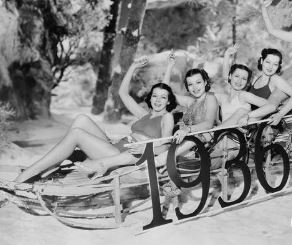
Despite the optimism coming out of our nation’s capital in 1936, the year stumbled out of the starting blocks to mixed reviews. While the country’s unemployment rate had dropped from its post-crash high of nearly twenty-five percent in 1933, it continued to hover just below seventeen percent. Economic recovery moved at a glacial pace. People were still suffering. And that’s even if you didn’t count the reported two hundred twelve deaths resulting from the severe cold weather across the U.S. in the last month of ’35.
The news in the international headlines seemed to be hurtling us toward another world conflict. In January alone, there were several significant occurrences. German officials announced Nazi treatment of Jews, including the intensified repression under the so-called Nuremberg Laws, was none of the League of Nation’s business. Italy persisted in its unmerciful bombing of Ethiopia. Denied parity, Japan quit the talks aimed at modifying the Washington Naval Treaty. Rumors of unrest among the population in Spain, fomented by communists, filtered across the Atlantic. Josef Goebbels declared Germany needed colonies for raw materials. As if in answer to these events, the U. S. Army adopted semi-automatic rifles.
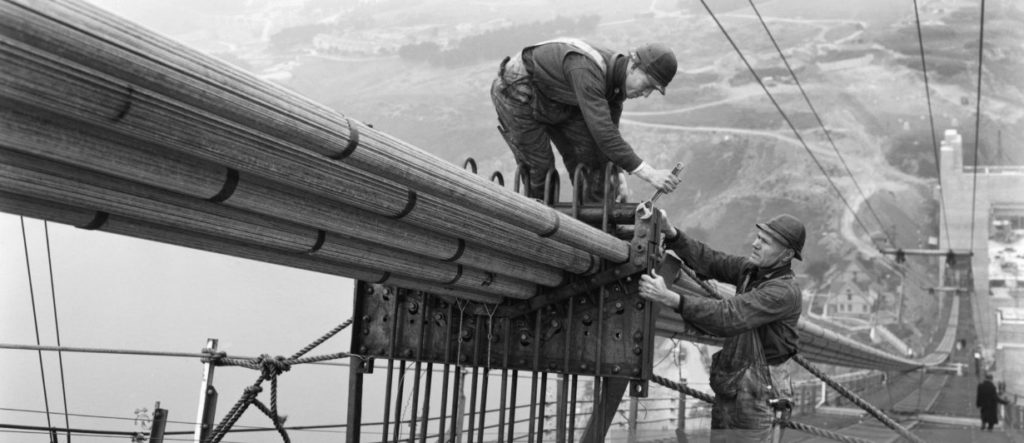
On the home front that month, we were blissfully pre-occupied with the following “monumental happenings.” Billboard magazine published its initial music “Hit Parade.” The first American building to be completely covered in glass was finished in Toledo for the Owens-Illinois Glass Company. The premier of the Green Hornet radio show aired on station WXYZ in Detroit. Construction of the Golden Gate Bridge progressed as scheduled. The inaugural players (Ty Cobb, Babe Ruth, Honus Wagner, Christy Mathewson, and Walter Johnson) were elected to the Baseball Hall of Fame. As a huge fan of the sport, this last item was significant to me, notwithstanding the other crises in the world. Sometimes it seemed the powers that be were trying to distract the population with “shiny objects” to keep our minds from contemplating the turmoil around us.
Sometimes it seemed the powers that be were trying to distract the population with “shiny objects” to keep our minds from contemplating the turmoil around us.
Meanwhile, as the calendar turned to the month of February, commerce at the Tanner Detective Agency was clicking along nicely.
Just as I was escorting the pudgy form of Richard Head, a lawyer for whom I did occasional work, from my office on a Wednesday morning, the ringing telephone pulled me back to my desk. I clawed the receiver off the cradle and greeted the caller. Following a few seconds of garbled noises, a thickly accented voice came on the wire. From my limited experience with foreigners, I guesstimated the fella to be of an Eastern European origin. But his manner of expression was different, heavier than that of my drinking associate, J. W. Altmeyer, and my mechanic, Max Eberhardt, both of whom were German-born.
Though I didn’t catch his name clearly the first time, whatever it was went along with the inflection. Straining to comprehend his words initially, my ear gradually grew to understand him better. He asked to see me, and we agreed to meet that afternoon in the bar of the St. James Hotel. Usually, I preferred meeting clients in the privacy of my agency, however he insisted on the hotel. Suddenly there was dead air on his end of the line. I waited for a click, then hung up. Having odd birds for customers was nothing new to me, so I let it drift.
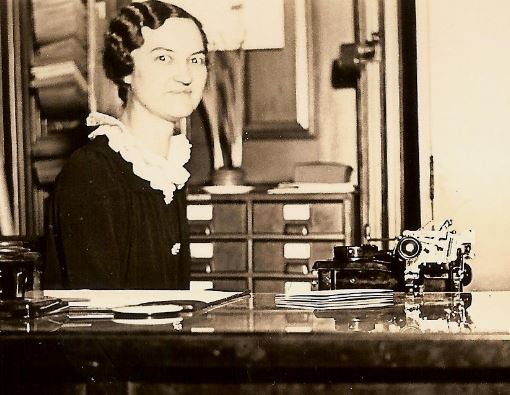
I spent the time between the call and our appointment typing the final report on Attorney Head’s matter. Swinging by the mouthpiece’s stomping grounds on my way to the rendezvous, I battled past Elvira, his hard-bitten, sinewy, desiccated old prune of a secretary, and personally delivered my file to her boss. The woman was a force to be reckoned with. If the Huns had had her on their western front, the AEF might still be in Europe. Nonetheless, I departed for the St. James with the lawyer’s last payment for my work tucked snugly in an inside suit coat pocket.
* * *
At the appointed hour, a man, wearing an expensive overcoat and a Borsalino hat, entered the bar. When he removed the outer garment, the fellow wore a carnation in his lapel, as my potential employer had said he would. He paused at the entry to flick something from his vest. Before acknowledging his presence, I studied him for a few seconds, as I do with most people I meet for the first time. The gent was tall and carried himself with great dignity. Beneath a shock of meticulously combed black hair with a touch of distinguished graying at the temples, he had piercing blue eyes and sported a stiff military mustache, turned up slightly on the ends. I put him at around forty years old.
I finished my drink at the bar and crossed the room to him, extending my hand and identifying myself. With a slight, rigid bow, he introduced himself as Dmitri Gurkakoff. His accent was less of a hindrance to my understanding him in person than it had been over the blower. We adjourned to a table where he ordered a Vodka Sidecar and I requested my usual, a Jack Daniels neat.
After shooting what could best be described as savage, suspicious glances around the tavern, Mr. Gurkakoff immediately got down to cases. He explained he believed his wife, Priscilla, was being blackmailed. By whom and for what, he was unaware. He’d discovered the situation accidentally and had not told her of his finding. He steadfastly refused to expand on how he learned of his wife’s plight.
Dmitri expressed his deep devotion to and protective nature regarding her. The man wanted nothing to disturb their otherwise idyllic life together. It was in his nature, he elaborated in a severe tone, to settle such matters himself surreptitiously, but, in this instance, decided to let a private investigator handle it. The way he stated that notion of revenge struck me as odd, but I said nothing. He wanted the extortionist found out and stopped, but with, he repeatedly insisted, absolute discretion and confidentiality. I assured him I never spoke of my clients or assignments, because, when a PI runs his mouth, patrons don’t come to his door.
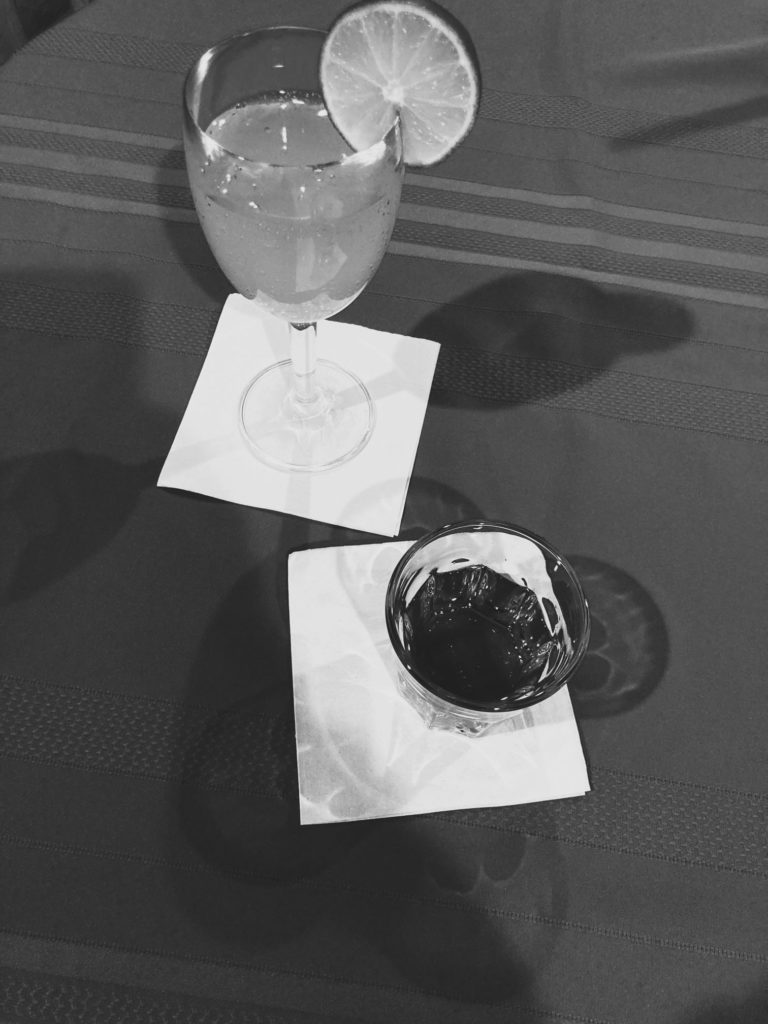
Before Dmitri discussed the matter further, our drinks arrived. At that point, my tablemate tucked a napkin into the winged collar below his chin and spread it across the front of his suit. Except for his height, his general appearance and fastidiousness put me in mind of a fictional Belgian detective I’d read about years earlier. Although the author described her protagonist as being from a different country and much shorter than the guy seated across from me, Gurkakoff seemed remarkably like the main character in The Murder on the Links. He appeared to be obsessed with the neatness of his attire. To be seen otherwise would seem to have wounded him as surely as a gunshot.
When I offered him one of my Chesterfields, he declined and retrieved a Balkan Sobranie from a small tin he carried. Based on that second clue, I tumbled to the fact that he likely hailed from Russia. However, that part of the man’s background was left unmentioned. Over our cocktails, my companion detailed the facts of his marriage around five years earlier to a girl who had then only recently arrived in our city from Chicago. When they’d married, his wife possessed a good sum of money in her own right.
Based on that second clue, I tumbled to the fact that he likely hailed from Russia.
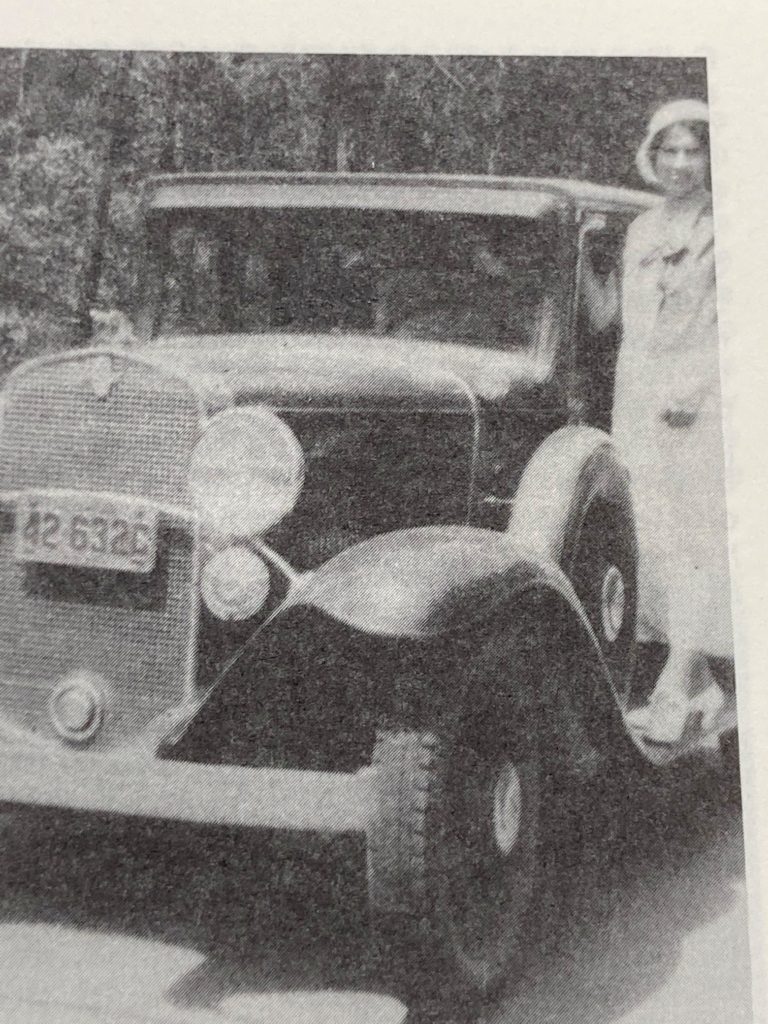
Gurkakoff spoke little of himself or his past, except in the context of his life with Priscilla. While handing me a snapshot from his billfold, he told me she had never worked during the time they’d been wed. The photograph, showing her standing on the running board of a ’31 Chevrolet, was of poor quality for identification purposes. I glanced at it and gave it back to him.
He explained further that Mrs. Gurkakoff rarely left their residence. That was sure to make my job slightly more difficult, though I assumed she left their home in order to hand money to the man shaking her down.
Before I broached that subject, my prospective employer told me their housekeeper had inadvertently mentioned that Priscilla was going into the city every Tuesday. It was what first put him on the notion she was involved in something out of the ordinary. Without clarifying how he knew, Dmitri said he was certain she wasn’t having an affair. He finished his statement of their circumstances by telling me they’d never had children, nor did the couple have any relatives living in our region.
I had watched him closely as he talked. In his demeanor, he projected an underlying suspicion of everyone and everything. It was particularly noticeable in those striking blue eyes, which frequently surveyed the room furtively. Possibly, the character flaw, as some might describe it, had come to the surface because of his wife’s unexplained activities.
This being Wednesday, it meant I had time to get a better handle on the situation, to work through some things. I informed Dmitri that, despite the snap he’d shown me, I needed to lay eyes on her in person. After a brief pause, an expression of relief crossed his face. He reminded me that Friday was Valentine’s Day, and he planned to take his wife out for dinner at The Copper Door restaurant to celebrate. He said they’d be there around eight o’clock. I told him I’d also be there to get an unobtrusive gander at Mrs. Gurkakoff. Though the eatery acquired a reputation over the years of catering to the carriage trade, I figured, with business being what it was and the nature of the celebration, I could afford to splurge.
Eventually, we discussed my fee. He balked slightly when I couldn’t give him a definite timeframe to complete the task he wanted done. Nevertheless, he hired me and paid me a cash retainer for the first two weeks. I assured him I’d keep him informed of my progress on the matter. In addition, I promised to provide invoices of my time spent on the job, which would list any expenses I incurred. When his eyebrows raised in skepticism, I confirmed I wouldn’t include the Friday night repast in any outlays.
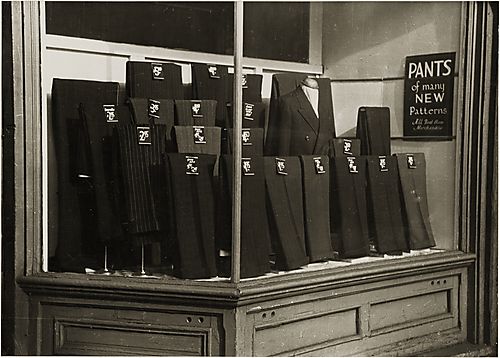
Suddenly, he removed a pocket watch from his vest and professed he had to return to work. We finished our drinks, and he paid our tab. Before we departed, he gave me the telephone numbers at which I could reach him, but again insisted on discretion when I contacted him. He agreed to notify me if anything changed as far as Priscilla’s regularly scheduled trip into the city. We walked out into the frigid February weather. When I bid Dmitri a good day, I hesitated, setting fire to another fag, and watched him walk a distance along the block before turning into a building. I ankled in that direction and realized he’d entered the G&G Haberdashery.
Through the store’s display window, I saw him greet a well-dressed man, drape a tailor’s measuring tape around his neck, and begin straightening articles of clothing. When he looked toward the front windows, I ducked from his view and strolled along the icy sidewalk. He didn’t need to think I was tailing or mistrusted him. At least, now I understood his desire to meet at the St. James, a location convenient to his store. It also explained his state of sartorial splendor.
Yet, the fellow was something of an enigma: a ruggedly handsome, soft-spoken man–beyond the guttural speech pattern–with the undercurrent of a hard edge and without an apparent ray of humor in his character. However, he was a devoted husband, bent on protecting his wife. Now he’d passed that burden on to me.
At that point, I felt I was operating under what one of my college professors–for the very brief time I spent at the institution–once called “ignorance squared.” I didn’t know what I didn’t know. But I had forty-eight hours before Friday’s engagement to fill in the blanks surrounding my new client and his wife. Getting to learn something about my employers’ backgrounds was a habit with me. And because it was important to fit in properly with the swells at the restaurant, I needed to get a date for that evening.
At that point, I felt I was operating under what one of my college professors … once called “ignorance squared.”
* * *
First, my natural curiosity led me to a few hours digging through our city hall’s records and the Carnegie Library stacks. Between both sources, I determined Gurkakoff had started a number of years earlier as one half of the highly successful G&G Haberdashery business. The clothier specialized in expensive, bespoke suits, which will help you appreciate why I was unfamiliar with the joint. The other person in the duo, Jacob Goode, better known as Jake, had died unexpectedly several years ago from meningitis.
Apparently, the two men had what the shysters called the right of survivorship in their enterprise. When Goode passed, his partner took the trade over and never missed a beat. My research revealed little else. No records surfaced regarding the man before the establishment of the haberdashery. Though pretty well off by the standards in a year where the average annual salary barely broke the seventeen-hundred-dollar mark, it appeared neither he nor Priscilla was inclined to socialize much. If they did, it didn’t find its way into the society pages of the local broadsheets.
* * *
A quick stop by the United Trust Bank on the corner of Market Street and Virginia Avenue to deposit Attorney Head’s payment and most of Gurkakoff’s retainer was in order. Then, I returned to my agency to create a file for the Russian’s case and to jot notes in it. Afterward, I made entries to my ledger book and generally checked on a few other things.
Next, I set my sights on finding a date for Friday evening. Not having a steady at the moment, I turned to an old pal, Lois Olsen, who I ran around with occasionally. It’s kind of difficult to explain our bond.
* * *
Lois, a local journalist, was really stacked, easy on the peepers, and what my grandmother might have called a “corker,” that is, a hoot to be with. Olsen had always put her career ahead of any romantic interests. As a result, she dated little, and that was unfortunate. The way I saw it, the frail had only two issues that kept men from approaching her: her height and her occupation, both of which intimidated a lot of eggs. While taller than most mugs, she was just slightly shorter than my six feet, so that wasn’t a problem for me. As a private investigator, her job as The City Chronicle’s crime beat reporter, a tough, male-dominated racket, didn’t faze me either, as it apparently did some men.
She’d earned her stripes by starting out writing a “Biscuit and Baby” bit. Then Olsen had moved on to a ‘Girl About Town’ column before working her way up to the police beat. Besides having a reporter’s nose and eyes for details, she had a reputation as one smart, tough cookie.
We’d started seeing something of each other subsequent to her helping me out of a tight spot in an investigation a few years earlier. That’s another story for some other time. I’d taken her to dinner and a movie as a sort of “thank you”–complete with flowers, I might add–and found out we had a lot of interests in common. It progressed from there to a strong friendship. Ours was not an exclusive relationship, nor had it advanced to what a few might term “adult activities.” Although she and I had gone out on the town frequently–with drinks, supper (sometimes where there was a band and a dance floor), a moving picture, or maybe a prizefight–, we’d become more buddies than anything. But how could I not love a woman who tossed around the terms “broads,” “bushwa,” “boiler,” and “bunco” in general conversation?
Ours was not an exclusive relationship, nor had it advanced to what a few might term “adult activities.”
* * *
I telephoned the daily’s city room and asked for my pal. The guy on the other end of the wire told me she’d been at the courthouse covering a trial but was on her way back. I’d forgotten the Elliott Hallstrum double-murder case was underway, and Olsen had been on the story for the newspaper.
As a fella who never relished rejection, especially on the phone at the hands of a skirt, I decided to go find her and make my proposition in person.
* * *
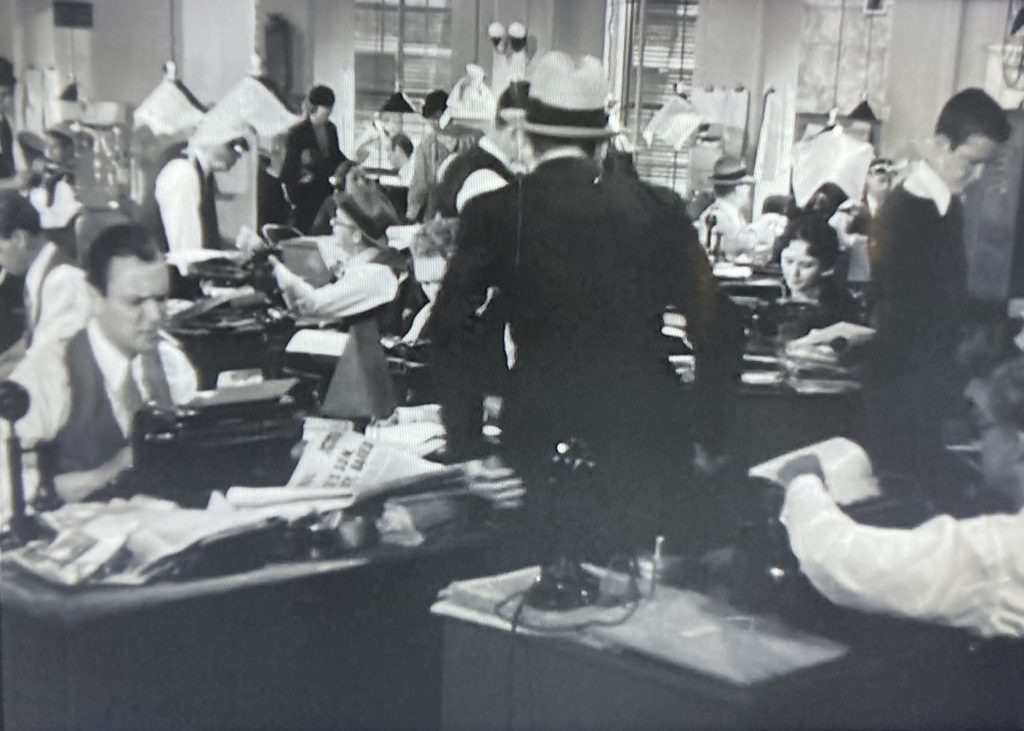
When I pushed through the swinging doors to the paper’s nerve center, the place was a madhouse. Across the bedlam, Lois hurriedly pounded out a lead on her trusty Royal #10 typewriter. Through the windows of his office, I saw Jeff Randall, the City Editor, on one of the phones on his desk. He lifted his chin in my direction as a greeting. I raised a hand in reply.
As I approached, Olsen pulled the typed sheet from the carriage and set it under a thin stack of pages. “Boy!” she shouted. A young man hustled to the reporter. “Take this to Satterfield and tell him this article calls for at least a two-column head with fourteen-point bold above the fold! And he needs to use the picture Abner took in the courtroom. He’s developing it now. Headline over the photo and caption underneath. Fit the story in below the picture.”
The kid loosely nodded, snatched up the document, and sped away. Just as she put a calming palm to her forehead, my buddy saw me. She grinned, which was always a good sign. “Whaddya say, Gil? What brings you to this loony bin?”
Dodging yet another scurrying reporter, I eased to her desk, threw a hip up on a corner, and scanned the disorder. “What in the world is going on? I know the Japs are in Manchuria, but did Germany start another war?”
She snickered and stretched her voluptuous form back in her chair, throwing her hands above her head. “No. But close enough. Mussolini’s still bombing the hell out of Amba Aradam on the northern front in Ethiopia. So Chuck’s running ragged checking the wire services for the latest. Roger,” she continued, nodding her way around the space at different folks, “is helping with the international news by gathering info for a follow-up story on King George V’s death and funeral.
“Your fellow horse player, Toby, is in the teletype room scanning for any information from Germany on the IV Olympic Winter Games.” While she paused for a heavy sigh, I spotted Toby Boyer across the pandemonium through an open door to the aforementioned chamber. For a lug who closely tracked the ‘sport of kings’ for a living, he couldn’t pick winning nags any better than me. “Then there’s the news pertaining to the first Social Security checks being mailed out. And, other than millions of French workers going on strike and shutting it down and the severe cold wave that has swept across this country, breaking temperature records and crippling transportation services, not much is happening,” she finished cynically. She looked up at me and smiled sweetly. “Now that I’ve saved you the cost of the evening edition, what brings you here?”
For a lug who closely tracked the ‘sport of kings’ for a living, he couldn’t pick winning nags any better than me.
I stood, swinging my fedora against my thigh. “Well, after a tough day in court and a bout with the machine here,” I offered, jutting my jaw at her typewriter, “I figured you could use a drink.”
“You read my mind.” She said low, smiling seductively, “At least the part I’ll let you read.” Lois could be very kittenish that way. “Let me grab my hat and jacket.” As I helped her on with the coat, she asked, “The Press Room?”
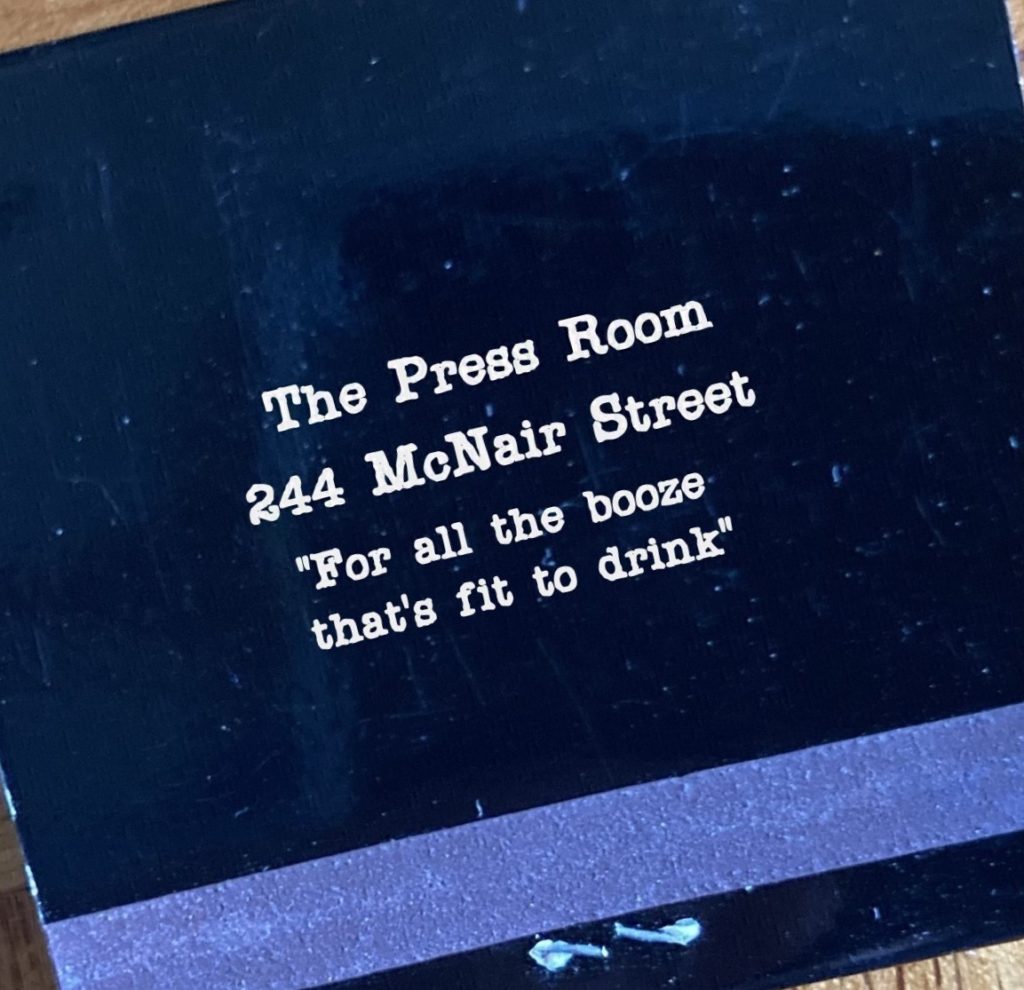
“Sure. Why not? It’s close.” The Press Room was a newshound watering hole, where you could always pick up the latest as-yet unpublished or unpublishable news stories as they mixed freely with the heavy pall of tobacco smoke and alcohol. It was centrally located to every rag office building and frequented primarily by the broadsheet crowd. You probably know of the tavern on McNair Street. If you’ve gone past it, you’ve likely seen reporters in various stages of sobriety stumbling out of the joint at all hours. Anyway, it was just around the corner and only a block from the Chronicle.
* * *
Twenty minutes later, we negotiated the icy steps leading to the gin mill’s below-street-level entrance. Inside, we made our way toward the rear to one of the high-backed booths that ran the length of the wall opposite the bar. The establishment was already littered with newspaper folks getting a head start on the evening’s imbibing. As I was slipping the twist out of her overcoat, I scanned the saloon. My thoughts momentarily returned to a diminutive reporter for the Daily Telegraph named Zier I’d been hired by several years earlier. We’d met here to discuss his case. The matter had been resolved, only to have him murdered in a totally unrelated situation nearly twenty-four months later. The recollection materialized every time we came into the bar. I won’t soon forget the poor little sap.
Shaking myself out of my reverie, I called to Al, the bartender, for a round of our usual drinks: J&B Rare with water for the lady and Jack Daniels, neat, for me. He stopped absentmindedly wiping glasses and acknowledged my request. Meanwhile, my companion took the seat closest to the entrance, so I had my preferred spot wherever I went, one facing the door. Lois knew my quirks by then.
“Fag me, Gil,” Olsen prompted, tossing me a matchbook from the table’s ashtray. Because a heavy cloud of smoke drifted through the bar already, I wasn’t sure whether I needed to light my own coffin nail or merely breathe deeply. Regardless, I pulled two Chesterfields from a new deck, set fire to them, and handed one to Lois. She took a long drag on the thing and released it slowly. A pale gray tendril of smoke curled in front of her eyes toward the ceiling.
Just as I was ready to ask her out, Al arrived with our drinks. I waited. We raised our elbows from the table while he wiped it with a dubious bar rag. As he did, he asked, “I overheard one of the fellers say the court ruled in the papers’ favor. That right?”
The woman across from me waggled her head. “Yeah, Al, they did. The Constitution doesn’t allow any restraint of the press that poses as taxation.”
“Good,” was the man’s only response before he shuffled away.
“What’s that about?” I inquired.
“In simple terms, the Supreme Court just rendered a ruling that put the kibosh on a tax Louisiana imposed on newspapers. Sounded to me like the shenanigans of some of Huey Long’s acolytes.” She sipped her scotch. “Imagine, freedom of the press actually applies to its publishers,” she snorted sarcastically.
At a loss for any information on that news item, I simply smiled and watched the barman return to his station. Some time ago, my reporter friend had shared with me that Al Bucofsky was more than the barkeep; he owned the joint. He’d been a Linotype operator at the Chronicle until a wealthy distant uncle passed away and left him a sizeable nest egg. Bucofsky had jumped at the chance to leave the paper and go into business for himself. But he had too much ink in his veins to say goodbye to his lifelong buddies at the dailies. The timing had been perfect with the repeal of the Volstead Act having recently occurred. Thus, The Press Room, which had become a wildly successful endeavor, had opened its doors.
Lois returned me to the moment. “So, is this just a sociable drink or do you have an ulterior motive, mister?”
“Well, it’s been a little time since we’ve gotten together, so I thought I’d kidnap you so we could nibble a few.” She showed an expression that told me she wasn’t totally convinced by my explanation. Did I mention Olsen was a smart cookie? “There’s that, and I was wondering if you had plans for Friday night.”
She flicked her cigarette at the ashtray. “I dunno. Maybe take in a picture show. Care to join me? Or do you have any other suggestions I might take you up on?” she finished playfully.
“If you’re game, I thought we’d go out to dinner.”
“Dinner, hmm? Sure. I haven’t had a meal at Mama Cappacino’s since we last ate there.” The lady had been a victim of my passion for the Italian restaurant.
“I was thinking of something other than Italian. What would you say to supper at The Copper Door? We could–”
“The Copper Door? Wow! A feed bag at Cappacino’s and seeing The Secret Bride at the Modjeska Theater is one thing, but–.” Olsen stopped and paused for a second, giving me a hard squint. “Say, I just realized that Friday’s Valentine’s Day! Dining at a swanky place like that on Valentine’s Day is on a whole new level for us, Gil. Are you–?”
“Say, I just realized that Friday’s Valentine’s Day! Dining at a swanky place like that on Valentine’s Day is on a whole new level for us, Gil.”
“All I’m trying to do,” I interrupted, “is invite you out for a nice dinner on a night that happens to fall on that day. Whaddya say?”
“Well, for thousands of years,” she replied, stubbing out her cigarette, “people baked their own bread or bought it by the loaf and cut it at home. The system worked. Then this mug Rohwedder came up with a machine several years ago. Now loaves are sliced, packaged right out of the oven, and sold in grocery stores. Things change, I guess. Progress can be made. Sure, why not?” She shot me that unconvinced look again.
Based on her comment, I suddenly felt as if, commitment-wise, I was “stomping on thin ice,” as my old buddy, The Professor, might say. “Okay, listen. I can’t get anything past you,” I sighed, deciding to fess up. “There is another angle for the dinner that evening.” Lois smirked and nodded knowingly. “I’ve been hired by a guy who wants me to look into a matter involving his wife, who’s something of a recluse. But I need to lay my lamps on her. He’s taking her there Friday night, and it may be my only chance to eyeball the dame before I start work on the investigation. But I really want to take you out and spend time together, too.”
She reached across the table and touched my hand. “Fair enough. We have a date.”
Relieved and pleased, I moved on. “So what’s going on with the Hallstrum trial? The rags made it sound as if it was winding down.” The man in question, Elliott Hallstrum, was charged with fatally shooting his wife, Abigail, and her lover, Salvatore Bucci, in their love nest at the Sterling House Apartments. “Sal the Sheik,” as Bucci was known around town, was a womanizer. It was said he could spot a good-looking woman from a Curtis airplane in midair. Sal was a mid-level gangster in the north side mob. In covering the story, Lois had hung the moniker “Hot-headed Hallstrum” on the jilted hubby. The girl loved alliteration.
“The jury has it as of this afternoon. The district attorney is hoping for a quick verdict–guilty, of course. Elliott’s lip told me he thinks the longer they’re deliberating, the better the chance for a hung jury or an outright acquittal.” Lois took my pack of gaspers from the table and freed one. I struck a match and held it out for her. She bent toward the flame, inhaled, threw her head back, and blew a plume of smoke.
“In the end,” she went on, “the defense was relying on the jurors buying his story that the actual victim in the case was Elliott himself. Bucci was a skirt-chasing louse who needed killing. And the two-timing broad’s death was an accident. Elliott’s mouthpiece even claimed a cowardly mobster used Abigail as a shield when her husband started shooting.” She exhaled audibly. “We’ll see. Bad decisions make great stories.” Olsen leaned back in the bench seat, closed her eyes and stayed silent for a bit while rolling her empty glass between her palms.
I signaled for another round of drinks and sat quietly, watching Lois’s expression. She appeared worn out. When the hooch arrived, her peepers flashed open as if she had some sort of booze detection system. I laughed, and she sheepishly joined me.
“Here’s to justice, no matter what form it takes,” I proposed, hoisting my glass. Lois raised hers. “All I can say is the numbskull’s lucky the coppers got to him before the mob did. Word on the street is they wanted to wreak their revenge on him for killing one of their own.” My running mate merely bobbed her head in agreement.
We spent the rest of the time trying to eliminate as much of Al’s stock of our favorite beverages as possible. Upon our departure, I managed to get Olsen back to her car and find mine before calling it a night.
* * *
Hard sunlight streaming through my windows pulled me into another morning. I laid there for a while, clearing the cobwebs crowding my cranium. That alliteration thing was contagious. In due course, I climbed out of bed, grabbed a shower, dragged a razor across my puss, and prepared to face the day.
With a quick breakfast at The Wayside Café under my belt, I motored through the ice and snow to Malaprop’s Bookstore. My friend, Micah Kaplan, was the owner-operator of the business. The visit had two aims. One was to pick up a book the store owner had called to tell me he’d gotten in.
My second, but more important, aim was to see what the shopkeeper might know about Mr. and Mrs. Dmitri Gurkakoff. As was my usual practice under such circumstances, I wanted to probe the man’s brain. Micah was a keeper of general information regarding the world and local knowledge and lore, which made even the city historian envious. What my old pal didn’t know concerning our metropolis and its inhabitants wasn’t worth repeating. He was a good friend and a windfall to a mug in my racket.
When I entered the bookshop, the proprietor was bent over the counter, sipping a cup of tea while a classical music piece quietly wafted among the tomes. He laid the book he’d been perusing aside. We greeted each other warmly and engaged in a bit of small talk before he moved to a table behind the till. After poring through a stack of volumes there, he returned with my novel. As he wrapped it in his customary brown paper, I broached the subject of my newest client. Without ever going into the details of an assignment, I always spoke freely with him. I knew the smallish, wizened old fellow was closemouthed concerning our discussions. We’d built our relationship, at least in part, on mutual trust and confidentiality.
Without ever going into the details of an assignment, I always spoke freely with him.
Micah’s sly smile told me he had at least a small amount of dope to impart on the topic. “Let’s go into my office and talk.” When I gestured toward the front entrance, he read my thoughts. “The shopkeeper’s bell will alert me to any customers coming in. I’ll keep the office door open.”
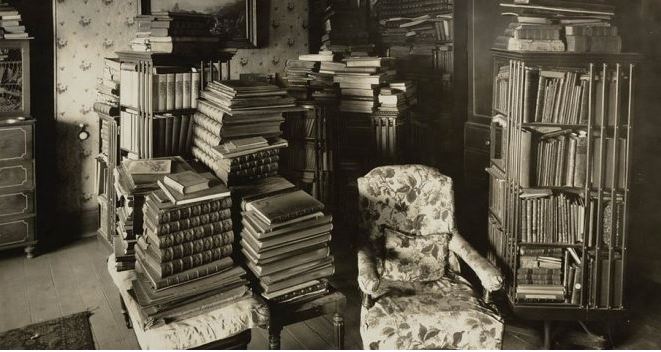
I declined his offer of tea and trailed him to the room, which was cluttered with stacks of books. Together, we cleared a chair, and I took a seat while my host sat at his desk. He leaned forward on his elbows and interlaced his fingers.
“Mind you, Gil,” he began, “what I can tell you is part speculation and part historical fact that has been smuggled out of the country by those who fled the Bolsheviks. Though it comes from a man I trust, I cannot swear to the entirety of its veracity. My source is an erstwhile Russian citizen in my congregation who shared this with me when we were leaving Jacob Goode’s family home as they sat Shiva. Jacob was also one of our congregants.” He looked deep into my eyes and continued, “The story goes that Gurkakoff, if that is even his true name, came here from Russia by way of England. Exactly when he left the motherland is uncertain, but he arrived here around a dozen years ago. The segment of the tale that took place prior to his settling here may be where the facts deviate from the rumors.
“I was told Gurkakoff had been caught up in the chaos that followed Lenin’s formation of the Chekas and their attempted purge of Petrograd. When plots, blockades, interventions, and failed and successful assassinations became too much, too dangerous for even a loyal party member, Dmitri, and others escaped. It’s anyone’s guess whether he was a part of the Cheka but had no use for the way they dealt with matters or if he was one of their proposed targets. Who knows?” he shrugged and leaned back in his chair. “Either way, it could make him a ruthless character.” He paused to drink tea, then added with a sigh, “History is nothing more than a set of lies agreed upon.”
“I figured he was simply caught up in another pogrom against the Jews.”
Kaplan scoffed, shaking his head. “He’s about as Jewish as a butter-drenched lobster.” Following another pause, he went on, “As for his wife, I know even less. What I have to share is she supposedly came here from Chicago nearly seven years ago. Rumor, again I emphasize rumor, has it she was a chorine or a chanteuse or some such there. I’m told she’s a fairly attractive woman. What I believe you refer to as a ‘darb.’ I’ve never seen her in person or in a photograph. For whatever reasons, the Gurkakoffs apparently enjoy little social life outside their domicile. I’m no Sigmund Freud, but from the things I’ve heard of the man’s moroseness, he seems to suffer from cherophobia.”
Cherophobia? I thought. Great! Another word to look up.
At that moment, a cluster of a few men and women entered the premises. I recognized them as members of the informal group known locally as “The Philosophers’ Club.” They frequented the bookstore to analyze and discuss intellectual matters. Time for me to move on.
I thanked Micah for his help, completed my purchase, and departed with it tucked under my arm. Lois and I had seen the film The Glass Key shortly after my return from an agency-related trip to Atlanta last year. The motion picture and a home-cooked meal followed by a Depression Cake were what Olsen had termed part of my “recuperation” from a couple of minor gunshot wounds I’d encountered on the journey. It was unnecessary, but who am I to argue with an attractive, shapely female who wants to pamper a fella a little? Anyway, the flick, which starred George Raft and the former Ziegfeld showgirl, Claire Dodd, was pretty good. Now I wanted to read the book to see what distortions Hollywood might have made of Dashiell Hammett’s story.
* * *
Returning to my agency, I dropped the novel on my desk, opened the Gurkakoff file, and made a few notes. Several minutes later, I tossed my pen, poured myself lunch from a bottle in a bottom drawer, and reflected on a newspaper article from late last year. The piece had recounted that, in recent years, for the first time in our country’s history, more folks left the country than entered. Hopefulness had turned to despair as the Great Depression wore on.
Paying their own way, many American citizens–over ten thousand in 1932 alone–departed for Russia. Their reasons could be summed up in three things the Soviet newsreels touted: full employment existed there, economic security was guaranteed by the government, and class antagonism had all but disappeared in the former land of the tzars. To stay, they’d had to take Soviet citizenships. However, the scuttlebutt was that Stalin was becoming increasingly more paranoid. That didn’t seem to bode well for the new immigrants. Time would tell how healthy the move might turn out for them.
Now, I’d been hired by a man whose past could have been intricately intertwined with the darker circumstances of the Russian Revolution. At least his money was good old American currency.
* * *
Late Friday afternoon, the radio broadcast word that Elliott Hallstrum had been found guilty of the double murder. Because of the facts in the case, the judge delayed sentencing until Monday. So long as the court proceedings didn’t interfere with my plans that evening, I cared little.
Date night finally rolled around. Because of the snow and ice storm our city was experiencing, I left my LaSalle parked safely where it was and called on my hack-driving pal, Mel Philpot, to provide us transportation.
Right on time, the cabbie picked me up and, a short while later, pulled to the curb in front of the Dunedin Arms Apartments. As I climbed out and approached the entrance, a doorman, decked out like an Italian admiral, opened the door, glanced out at the ongoing intemperate weather, and greeted me with a weary smile. When the elevator reached the sixth level, I prowled the hallway to Olsen’s unit, 635. My date answered my knock dressed to the nines in a snug navy-blue outfit cut low over the swell of her breasts. I pretended not to notice. She pretended not to notice me noticing. Somehow, I avoided gasping.
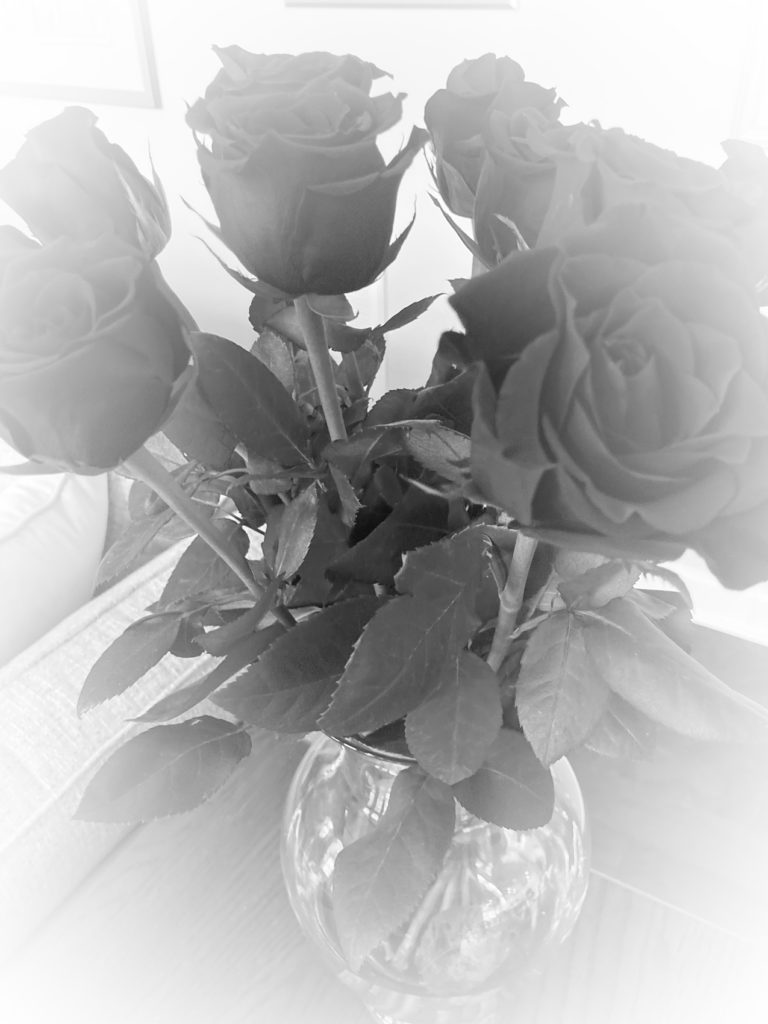
“Thank you for the roses!” Lois gushed, giving me a lingering kiss. The fragrance of the Tabu she wore on evenings out swept past me, awaking urges–impulses that one might consider inappropriate to have toward a pal. It was obvious I needed to send her bouquets more often. She pulled away too soon for me and said, “Give me a second, Gil. I need to get my wrap.” I saw the flowers displayed in a glass vase sitting on her sofa table nearby. She retreated into her living room and turned off her console radio, where an instrumental rendition of Willow Weep For Me played softly. Quickly, the girl returned with a cape, which I helped her into before leaving.
* * *

When he’d gingerly made his way along the icy thoroughfares, Mel eased to a stop at The Copper Door. On the sidewalk, Lois held her left hand out to me. I glanced her way. She admonished teasingly, “Let’s do it right, big man.” I extended my right arm, and she put the hand its crook.
Inside, the maitre d’ showed us to our reserved table. Across the restaurant brimming with an uptown crowd, I espied the Gurkakoffs. Our location gave me a good view of the missus as the pair conversed quietly. I covertly studied her features briefly. She was as lovely as I’d been led to believe.
I ordered our usual course of cocktails. While we waited for their arrival, I excused myself for a visit to the restroom. The trip allowed me to get an even closer up-and-down of my mark. She was a knockout, sure enough. Her sultry, dangerous looks had probably left more than one mug weak in the knees. Making my way past their table, I gave Dmitri a slight nod to indicate my aim had been achieved. He almost imperceptibly returned the gesture.
The trip allowed me to get an even closer up-and-down of my mark.
Back at my seat, I focused on enjoying a wonderful meal with the lovely Miss Olsen. Never one to beat around the bush, Lois scanned the room. As her carmine lips formed a mischievous grin, she asked, “Okay, so which of these blue bloods is your client? Or are you going to make me guess?”
“Well, guess if you want, but you know my position on confidentiality. I–”
“Yeah, yeah. You’re worse than a mouthpiece or a priest like that.” She reached across to me and gently caressed my cheek with her fingertips. “But I’ll worm it out of you,” the smoky-voiced brunette whispered. I believed she could, too. I swallowed hard.
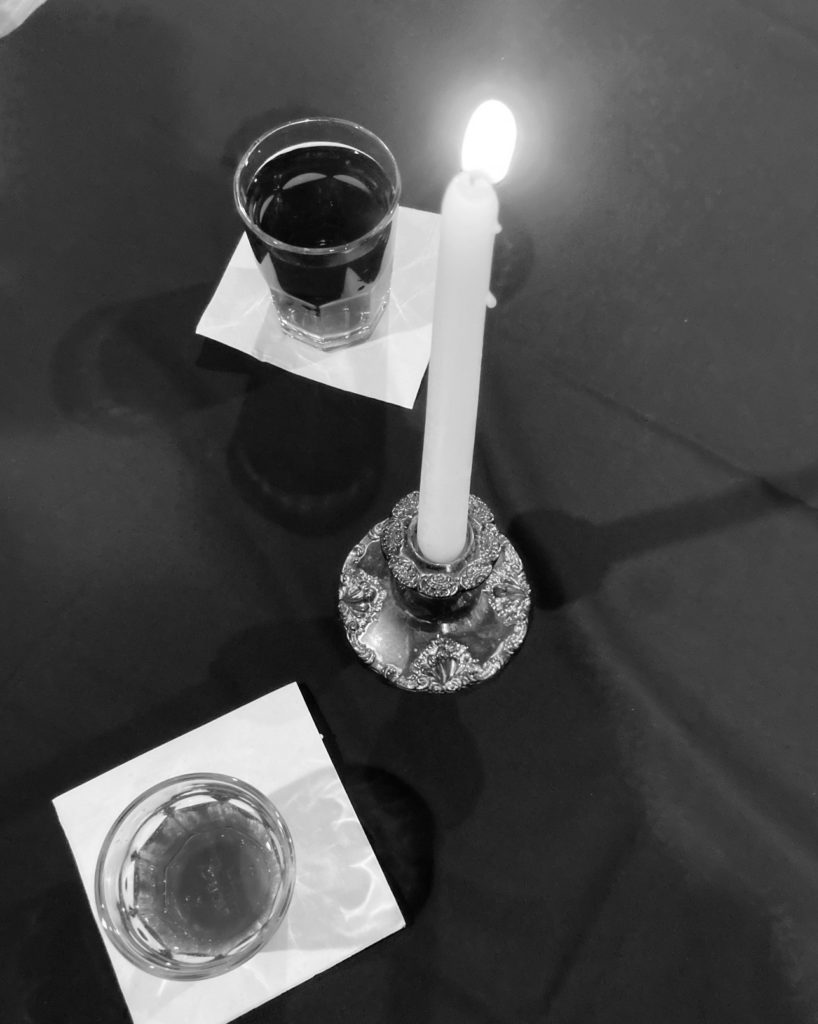
Thankfully, the drinks arrived just at that second, and we were occupied with ordering our meals. It provided me with the opportunity to change the topic. When the waiter departed, I raised my glass. “May the pleasures of the evening bear the reflection of the morning.” As our glasses clinked, I pressed on with moving away from her question. “So, do you think Hallstrum will get the death penalty?” Lois shrugged my inquiry off. It was usually her signal she didn’t care and / or didn’t want to discuss the matter.
I let it drift and moved on. “What’s the word at your broadsheet about a merger?” A trend to consolidate newspapers, controlled by the same owner or owners, had emerged nationwide lately. This had shown itself especially true if one was a morning rag and the other was an evening edition, such as with The City Chronicle and The City Herald. They were both owned by the immensely wealthy Babington family, who lived on an estate on the outskirts of our municipality. Rumors of such a combination of the two dailies had been heard around town. I saw it as a sign of the economic turmoil the country was experiencing.
“Don’t ask me. That sort of thing is above my pay grade. The sob-sister editors at The Chronicle can worry over it. To quote Pulitzer, ‘Every reporter is a hope, and every editor is a disappointment.’ I’m just a journalist, Gil. A snappy, snoopy dame who’s never been afraid to print the truth no matter what.” She sipped her cocktail and shot me a playful look with her bold black eyes. “And don’t think changing the subject will cause me to forget my question.”
I smiled at her astuteness and her candor. Lois hadn’t lied concerning her truth-telling, regardless of the consequences. A year earlier, she’d ferreted out a corrupt doctor in our Medical Examiner’s Office who was selling advance information to certain members of the two mobs that controlled the criminal element in our city. His under-the-table disclosures had kept them one step ahead of the law in most instances. The cutter had also been improperly passing inside dope to a reporter on The City Herald’s staff. Her revelation on that latter count hadn’t set well with Jeff Randall until she threatened to go public with his reaction to a municipal servant who didn’t have the best interests of the voters in mind. Her editor’s objections had faded faster than Hoover’s re-election hopes.
We spent the rest of the evening eating a delicious supper accompanied by sparkling conversation, which somehow avoided any further inquiries about my client. While Lois ordered after-dinner coffee, I used the restaurant’s pay station to call Mel at the Ajax Diner and arranged for him to pick us up.
As we stood to leave our table, I again extended my arm for Lois’s hand to rest on. She smiled broadly. “Well, you’re easy to house break.”
* * *
When we reached her apartment, someone had squeezed a note between her jamb and the door. Lois read it and explained she needed to call her paper’s night desk. We went inside, and I stood by while she telephoned. From her side of the conversation, it was obvious something had occurred requiring her attention.
Hanging up, Olsen ripped the page she’d made notes on from its pad. The brunette shot me a sorrowful expression. “I’m sorry, Gil, but I have to call it a night. They need me to go to police headquarters. It seems an alert beat patrolman noticed the beams of flashlights crisscrossing the inside of a downtown jewelry store. The coppers pinched a trio of ne’er-do-wells pulling the burglary. They think it might be the same gang that’s been hitting businesses for the past several months.” She walked to me and gave me a hug and a kiss. “Can we take this date up another evening soon?”
“It seems an alert beat patrolman noticed the beams of flashlights crisscrossing the inside of a downtown jewelry store.”
“Sure. Any time, Lois,” I readily but reluctantly agreed as she took my arm in hers and escorted me to the door. “Mel’s waiting downstairs. Do you want us to give you a lift to HQ or the paper?”
“No. Thanks. I’ll need my jalopy to run around between the crime scene, police headquarters, and my desk.”
“Makes sense.”
“I may be up all night, but I’ll call you when things get calm enough.” With that, we shared a platonic kiss goodnight, and I returned to my bedsit. It was just as well. Raging hormones, I believe the eggheads called them, can really mess up a wonderful friendship.
* * *
I found myself at a standstill until the following Tuesday, unless I heard otherwise from Dmitri. Having to wait to work an investigation once I’d been hired made me crazy, especially when I had nothing else pressing to keep me busy. So I used Saturday morning to find the Gurkakoff’s residence on Briarcliff Trail in the well-to-do Hammond Hills community on the northeast side of the city. Two prior cases had given me a working familiarity with the enclave.
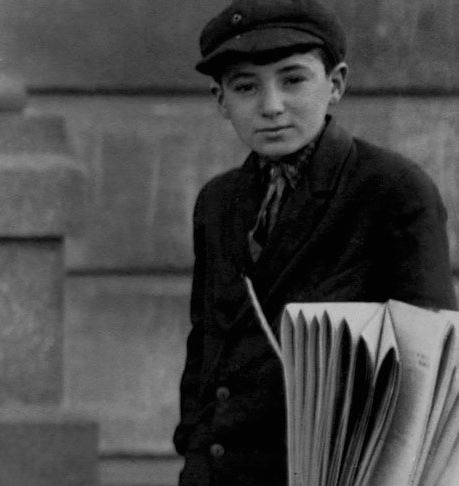
The stately home was located with no problem. I then returned to my agency, grabbing a copy of the Chronicle’s bulldog edition from Mose, the newsboy of tender years outside my building. Trying desperately to help his family’s financial circumstances, Mose had shown himself to be a good kid. His face was seldom washed, his hair never combed, nor his teeth brushed, but he stood on that corner, rain or shine. I always gave him a nickel for a two-cent rag.
I made a pot of coffee on my office hot plate and spread the daily open on my desk to catch up on the latest. Olsen had two front-page articles, both “above the fold,” as she liked to say. The first was a follow-up piece on the Hallstrum conviction. The banner headline read as a query regarding whether they’d give the killer the death penalty. I’d long held a theory about what I saw in the press. Any headline that ended in a question mark could be answered by the word no. If the answer were yes, the thing would be in the form of a statement and end with an exclamation point.
However, this appeared to be a situation where my hypothesis could be wrong. Despite the facts showing the defendant to have been made a cuckold by Abigail, there was a strong animus among the citizens toward him. The continuing wave of criminal activity that enveloped the country had tarnished any sympathy the American people felt for lawbreakers during prohibition. And I felt certain Judge Whalen, the presiding jurist, was keenly aware of it.
Lois’s second item covered the attempted jewelry store heist from Friday night. Two of the three culprits were known to those of us who regularly dealt with the underbelly of our city’s criminal element. The duo ranked high among the intellectually challenged in that particular subculture.
Little else in the news caught my eye. With baseball season openers still two months away and nothing in the way of bangtail races to grab my attention, I made a quick scan of the funny pages just to kill time. Joe Palooka, Flash Gordon, Jungle Jim and the rest of the comic strip gang didn’t help my frustration any. I tossed the newspaper aside. Time for a visit to my favorite watering hole.
* * *
I took Lois to lunch at Mama Cappacino’s on Monday. As usual, Mama shot hopeful smiles between the reporter and me. Loyal friend that she was, the proprietor seemed eager for me to find a good woman and settle down. During the meal, Olsen and I agreed to another night out on the town soon.
* * *
Tuesday morning dawned much milder than the previous days had been. During the weekend, it appeared that winter might loosen its grip on the metropolis. It was still fairly chilly, but the ice and snow were slowly melting.
I grabbed my usual quick breakfast and stopped by the agency to pick up a few things I figured I might need. On the way back to my LaSalle, I bought a morning edition from Mose to occupy me while I waited for Priscilla to make an appearance. Then, I drove just past the Gurkakoff place to a spot, which afforded me a view of their driveway.
Stakeouts were one of my least favorite parts of the private detective racket, but they were a necessary evil. As usual, I slid across to the passenger side of the car. During my experience, I’d found sitting there during a surveillance gave anyone noticing the impression I was waiting for the driver to return. It’d be less suspicious to the casual observer. I read the Chronicle from front to back.
Only one news item caught my eye. Three men with pistols had assassinated Jack McGurn that past Saturday in a second-floor Chicago bowling alley. Significantly, it had been on February 15, one day after the seventh anniversary of the St. Valentine’s Day massacre. The article related the killers had left a Valentine card near his body. The underworld rumor mill always had “Machine Gun Jack” at least involved in the planning of the 1929 carnage, if not actually present. Although police had charged McGurn in the case, they never brought him to trial. That lapse was largely due to what the news ferrets had dubbed his “blonde alibi”—his girlfriend and later wife Louise Rolfe—who claimed the couple had spent the whole day together in a hotel. It seemed that gangsters, as well as elephants, never forget.
I laid the paper aside and waited. Around an hour and a quarter later, a municipal police officer drove slowly past my location. He turned into a driveway several houses farther along Briarcliff, backed out, and returned to across the road from where I sat. The big lug crawled out of his machine and ankled toward me, carefully eyeing the surrounding homes and yards. With nothing apparently out of order within his purview, he made his way to my passenger window. I recognized him as a guy I’d met through my city-cop brother, Marty. Hopefully, he’d remember me, too.
The big lug crawled out of his machine and ankled toward me, carefully eyeing the surrounding homes and yards.
“Good morning, Officer Detweiler.”
“Morning, Mr. Tanner.” I started to ask him to call me Gil but wanted him gone quickly so as not to draw attention to my presence. I cut that segment out of our conversation.
“On a case, I take it?”
“Yeah. Keeping an eye on a fella for a suspicious wife,” I lied. “Boring, but it keeps the wolves from the door.”
He chuckled. “Okay, then. I’ll leave you to it.” With that, he returned to his patrol car and departed. I recalled it was the second time the law had braced me while I worked a case surveillance in this neighborhood. The folks in the Hammond Hills community, which included politicians and prominent business people, drew a lot of water. The bulls certainly looked out for their interests.
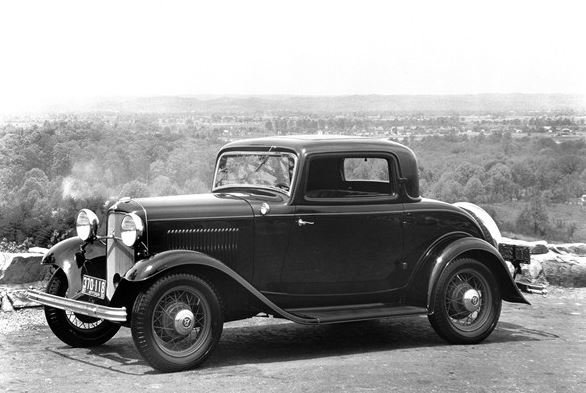
Just before noon, I poured the last of my coffee from a thermos just as my prey pulled from their detached garage to the road in the ’32 Ford coupe her husband said she used occasionally. She turned toward the city. In a few seconds, I took up the chase.
* * *
The coupe made its way to downtown and eventually eased into a parking lot on Broad Street. I spied a flivver pulling out of a spot on the thoroughfare just beyond the lot’s entrance and slid into the vacated space. I knew my quarry had to return in my direction since the area she’d entered was enclosed by buildings inaccessible from it. So I sat and watched. In no time at all, the doll appeared on the crowded sidewalk. Slipping from behind the wheel of my bucket. I fell in astern of her and kept pace at a distance. She walked with a confident air, giving no hint of concern that someone might be tailing her. Decked out in a maroon overcoat with a fur collar, she made an easy person to shadow. Several blocks later, the looker crossed Broad and moved south along Market Street.
My mark entered the Market Street Diner. I did likewise.
While she slid into a booth across from a slender, middle-aged man, I grabbed a stool at the corner of the lunch counter, from which I could watch them. I ordered a cup of joe and a sinker so I didn’t stand out in the crowd. Priscilla and her companion spoke in subdued tones. Whatever was being said, their conversation was not a happy one. Following a bit of back and forth, during which she repeatedly clinched her fists at the lowlife, she withdrew a thin envelope from her handbag and glided it past his coffee mug to him.
He snatched it up, peeked inside, and shot his victim a nasty sneer as he slipped it into a coat pocket. I expected her to react verbally, maybe tear up at the creature’s actions and attitude. But she merely kicked his leg hard under the table. It was a move that passed unobserved unless you were honed in on them. He grimaced, leaned forward, and drew a hand back slightly as if to slap her. He caught himself, dropped his mitt, and looked around to see if anyone had noticed. When the stranger’s gaze moved to me, I averted my eyes.
This had to be the payoff. Whatever amount she handed to the reprobate, it was clear she was in a jam. Mrs. Gurkakoff quickly abandoned her tablemate and the diner. Now, the jasper she left behind became my focus. After a minute, he slurped the last of his java, heaved himself out of the booth, and headed for the door.
I dropped a dime on the counter and took up the pursuit.
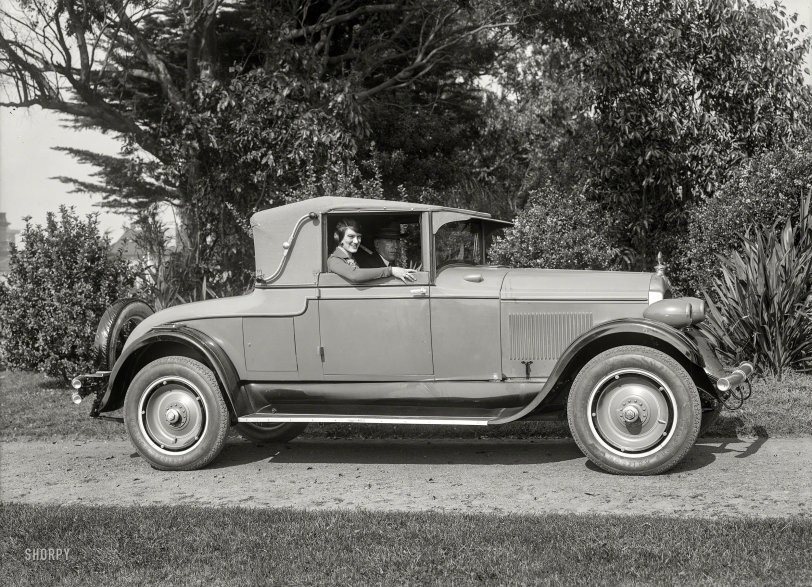
Out on the sidewalk, he confidently tugged down on his overcoat, shot his cuffs, and scanned the roadway in both directions. I put a match to a butt and waited for his next move. He sauntered to an old Paige Cabriolet roadster parked at the curb further along the block. As he cranked the thing to life, I hailed a cab to track him.
Now, the jasper she left behind became my focus.
* * *
The extortionist drove to Karnes Street, which intersected with Market and was lined with unpretentious apartment buildings. I had the cabbie pull to a stop a few doors away from where he parked and told him to keep his meter running. The man I’d been bird-dogging trotted up the steps and disappeared into one of the joints.
I asked the driver to wait, rolled out of the taxi, and mounted the steps to the entrance. It proved to be a building that, just outside the door, had a call button for each bedsit with which to contact the occupants and to allow them to let visitors in. Since the damned structure comprised five stories with several units on each floor, I had no way to tell which one was this mug’s place. So, I pressed the button designated “Manager.”
In short order, someone came to the door but didn’t open it. A stout, older woman pulled the dark curtain that covered its window aside and pressed close to it. “Yeah?” she yelled from a face resembling a withered apple. Raising my voice slightly to be heard through the closed entry, I told her I had spotted a lug over on Broad who looked like a friend I’d been stationed with in the army a while back. This “old military buddy” gambit that had proven successful in the past. Then I apologized for being unable to catch up with him before he entered the building and bothering her with my problem. I wanted to pay him a visit.
She opened the door a crack. But before she asked my friend’s name, I quickly described the tall, slender man around my age with short-clipped, dark-brown hair and a blotchy face.
I caught a break. “Oh, that’s Mr. Klein in 3C. Third story front. I thought I heard him come in a bit ago. Do you want to go on up?”
My investigative instincts told me it might be better to wait to size this goon up more before confronting him. “You know what, Miss–?”
“Mrs. Crowder. Widow Crowder, to be more precise.”
“I’m sorry for your loss, Mrs. Crowder. Anyway, the doughboy I knew was named Don Cogan. Different person entirely. Dang if this fella… Klein, you said–?”
“Yes, that’s right. Klein. Sam Klein. A salesman of some sort. Keeps odd hours. So I’m never sure when he’ll be in.”
“Well, if it’s the wrong guy, it doesn’t matter. He certainly looked like my friend, though,” I chuckled. “Thank you, ma’am. Sorry to trouble you,” I offered, tipping my hat. She smiled and closed the door as I trotted down the steps to the waiting cab, but not before glancing at the name card beside the call button for 3C. It read “Sam Klein.”
At the risk of missing this character’s comings and goings for a short period, I had the hack take me to my LaSalle.
* * *
I returned to Karnes and eased to the side of the road across from my target’s residence. At that moment, I considered another favorable state that had come my way. The landlady had said her tenant’s rooms were at the front of the building. As I took a slant at the width of the setup, it appeared that there was space for only one apartment facing the street. That should make monitoring Sam easier.
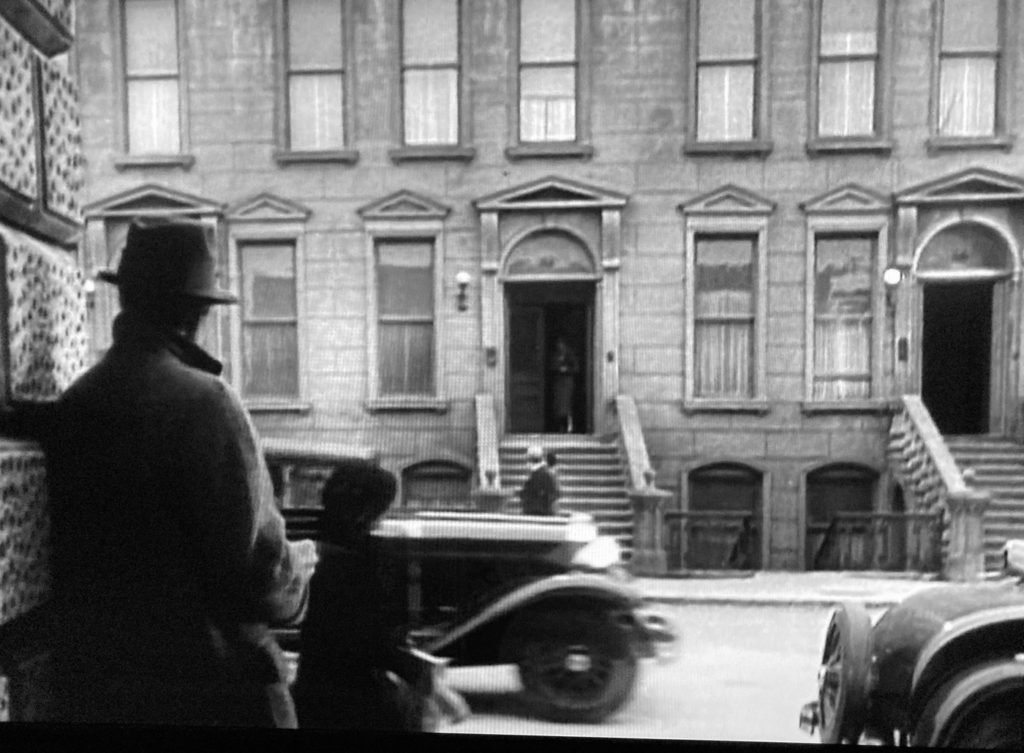
Initially, I took up a position across the street. But soon, because of a want of apricity as evening approached, I hunkered down in my beater as I kept an eye on the bum. In a while, lights came on in what I had supposed was his unit. I confirmed my theory when, with a pair of German-made opera glasses, I watched him appear at the windows and draw the shades. After I continued the vigil a little longer, it seemed to me the man had settled in for the night. It was time for this PI to call it a day, too.
* * *
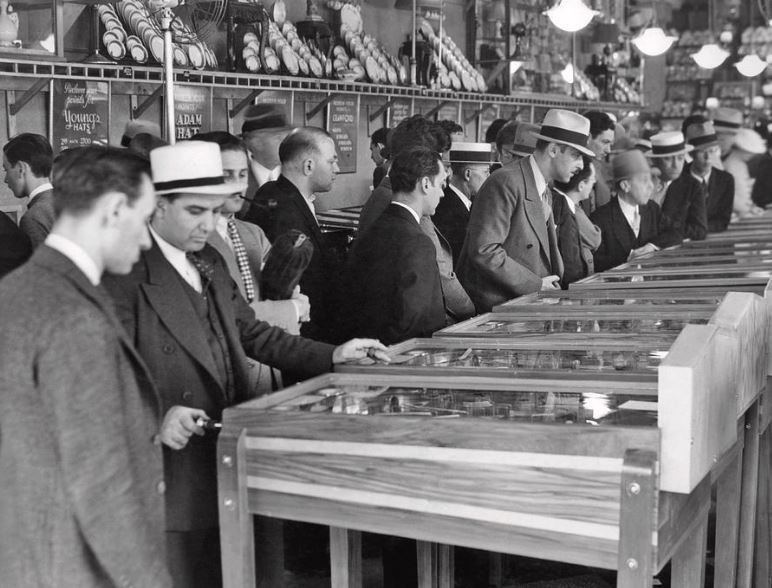
Over the next week, I determined Priscilla’s tormentor to be a creature of habit, my favorite sort of person to trail. He took his meals at the beanery on the corner of Market and Karnes. They were each a leisurely process which consumed (pun intended) an hour or so of his time. His lunchtime repast completed, he’d usually stroll to one of the movie houses along Market to take in the latest matinee offering or to that penny arcade on Decker Avenue, just off the main drag. The whole megillah kept him away from his home for at least two to two and a half hours, more than enough time for me to frisk it. Occasionally, he’d keep company with a redheaded skirt on these outings. Those excursions lasted longer.
The whole megillah kept him away from his home for at least two to two and a half hours, more than enough time for me to frisk it.
Meanwhile, I also determined that there was a narrow backstreet, saddled with the unexplained and unappealing name of Booger Alley, that ran between the buildings on Klein’s boulevard and those facing Swathmore Avenue, the parallel roadway one block north. A fire escape climbed the back of Sam’s building. I figured it could provide easy access to his apartment without hanging around for an unsuspecting tenant to provide entry or risk having Mrs. Crowder see me.
On a side note, I read where General Billy Mitchell died in New York on Wednesday of that week. The reports disclosed it resulted from a heart issue. Considering the way he’d been treated by the very armed forces he had served and fought for, I wouldn’t have been surprised if it wasn’t a broken heart.
* * *
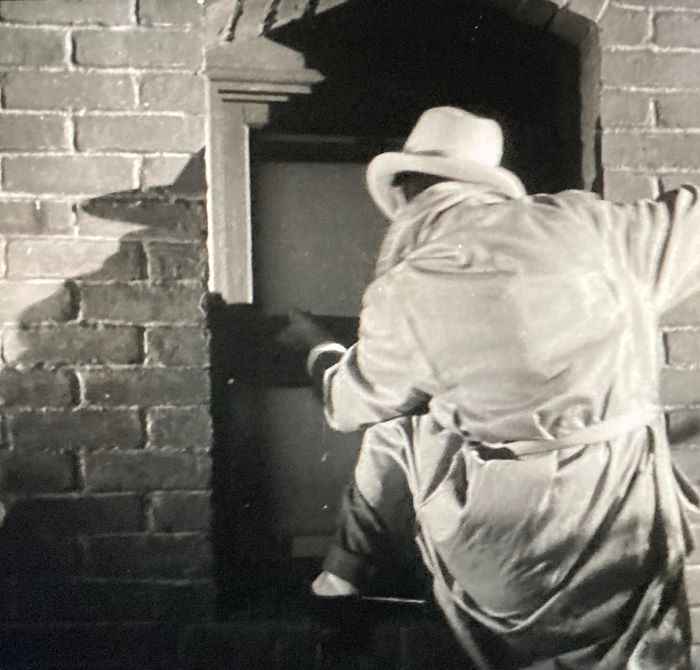
So, the following Monday, I made certain the shakedown artist was ensconced at his usual table in the café before hustling to the lane behind to his building. With the area void of humankind, I dragged two dilapidated trash cans to under the emergency stairway’s drop ladder, pulled it down, and clambered up. As I’d hoped, the landings at each level were at a window in the structure’s hallways. The third-floor one was unlocked. With no signs of life to deter me, I opened it and climbed inside.
The joint was eerily quiet except for the hot, sultry rhythms of a jazz band playing somewhere along the corridor. After checking the stairs in both directions, I prowled the passageway on a threadbare hall runner. As I paused at the apartment from which the music played, I heard soft moans. A knowing grin crossed my face. Continuing on, I passed the communal bathroom and located unit 3C. Next to the doorjamb was a small sleeve in which the tenant could place a card or piece of paper containing their information. 3C’s placard showed it to be inhabited by Sam Klein. The door was locked, of course. I pulled my picklock set from a coat pocket, scanned my surroundings, and bent to the doorknob. With a little effort, the lock gave way.
I quickly entered and closed the door behind me. The room was heavy with warm, muggy air. Heat emanated from a steam radiator going full blast under a window. Dampness came from the wet laundry hanging on a rope strung across the room. The bed was also made. Apparently, Klein was quite the little homemaker, at least to a certain extent.
My eyes swept the space. The rest of it appeared inconsequential at first glance. Beyond the grimy woodwork, dingy window shades, curtains of dirty cotton lace–I guessed the bedsprings probably stuck into your back, too,–the lodgings contained the usual furniture for such a residence. Besides the bed with a side table and lamp, the room held a bureau with a mirror, a straight-back wooden chair and a stuffed chair. Behind the upholstered seat stood a tall free-standing lamp with a square, red shade. A man’s tie was draped around a post of the bed’s footboard, and a towel hung over the back of the wood chair.
After checking the closet with nothing to show for the effort, I fanned the bureau, including the drawers’ undersides for any hidden documents or photographs. The only thing of interest I located was a .32 caliber revolver stashed beneath underwear in one drawer.
On a hunch, I removed the water pitcher from the wash basin that sat on the chest of drawers. Picking the bowl up and turning it over, I found a cocktail napkin from a lowbrow bar–dancehall–clip joint with the overly optimistic handle, The Hotsy-Totsy Club, taped to its bottom. I knew the dive to be on the southwest side of the city, where he’d first picked up his occasional female companion. It was one of the lesser lights of our city’s gin mill population. There tended to be a lower element out and about in that part of town.
Having the thing hidden that way struck me as odd. Just as I was going to pull the note from the vessel for a closer look, there was a commotion in the hall. I quietly hurried to the door, ducking the damp clothing in route, and listened. Someone clamored their way to the bathroom. I imagined it might be one of the lovers I’d overheard earlier.
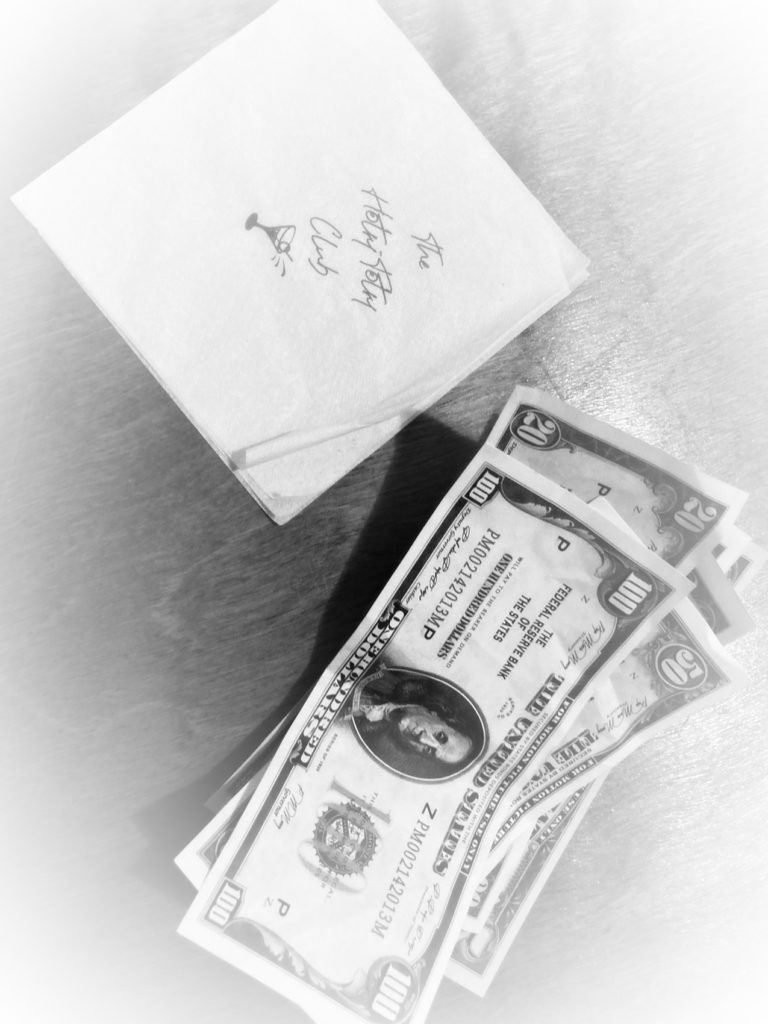
That resolved, I returned to the bureau and removed my discovery from its secret location. On its back, someone had written “Priscilla Duncan. Rainbow Garden Room. Chicago. 1929.” The thing was as close to anything significant that I had found in the bedsit. Because of the note’s probable relevance to my investigation, I shoved it in a pocket. Between the napkin and the basin were several hundred dollars in cash. I reattached the geetus to its hiding place. Then I replaced the bowl and pitcher as I’d found them and moved to the door. No sounds of life came through it to me. I cracked it open and peeked out. The corridor was empty and still.
Between the napkin and the basin were several hundred dollars in cash.
Retreating along the passageway to the fire escape, I made out a vocal rendition of Ain’t We Got Fun?, mixed with giggles, coming from that same apartment as before. At least someone was having a good time. ©
To Be Continued Tomorrow