
It seemed a lifetime since I’d been in the North Georgia mountains, and I’d never really thought about going back either. But when the phone call came to my home in rural West Virginia telling me that my daddy was dying and asked to see me, conflicting emotions tore at my heart. Although we’d not spoken in decades, he remained my parent and I his only child, his only living relative.
My husband, David, a software engineer for the Federal government, encouraged me to make the trip despite my concerns over opening old wounds. He was right, of course. I needed to go. David sympathized with my situation and offered to come along. But he’d never even met daddy, knew no one in my hometown, and wouldn’t have anything to do there. So we agreed that he’d stay behind and take care of our two granddaughters, who lived with us while our son and his wife were on a temporary assignment overseas. I’d go alone and do my familial duty.
The flight to Atlanta was filled with uncertainty concerning what lie ahead. As harsh as it may sound, and notwithstanding my “duty” as a daughter, the question kept arising: was this, in fact, the right thing to do? Why, after all this time, did he want to see me again? I really didn’t know daddy, and he didn’t know me. I’d grown up and away from him, the area, and the life I’d known as a child and young adult. “Relative strangers” was the way I’d often described our relationship to David.
Not that he had been a terrible father. We were just never close. My mother died giving birth to me. As the years passed, I grew to feel that daddy blamed me for losing “the love of his life.” He always appeared angry. His anger never took the form of any type of physical or overt mental abuse. But he always sounded as if on the verge of an explosion. And growing up decades ago in the rustic mountains did not help me cope with the circumstances. Although a natural tranquility was to be found there among the tall evergreens and hardwood trees, there’d also been a code of behavior to which one adhered when I was a child. Parents were to be obeyed. They were not the “buddies” that today’s parents try to be to their children. The hardscrabble life for poor mountain people did not allow such niceties.
After collecting my bags from the carousel and renting a car, I drove north, away from the Atlanta airport. My only time in the city, years ago, was merely to take a bus that took me away from everything I’d grown to dread and dislike about my life. As I traveled through the city on the interstate highway, nothing looked familiar. I wondered whether my daddy had changed as much as what I remembered of Atlanta. I knew I had. Yet, there was something comforting about going to see those highlands again. Maybe that’s why, when David and I were deciding where to live within commuting distance to his job in Washington, D. C., I more or less insisted on living in the mountains that ran along the line separating West Virginia and western Maryland.
The trip north from Atlanta led from one interstate highway to another as I ascended toward the peaks of my youth. Much of the manmade surroundings looked new and strange. Only the landscape felt familiar, somehow comforting. It wasn’t until the limited-access roadway became a divided, four-lane, scenic parkway that I realized I was traversing what had once been the two-lane road I’d used years ago to leave.
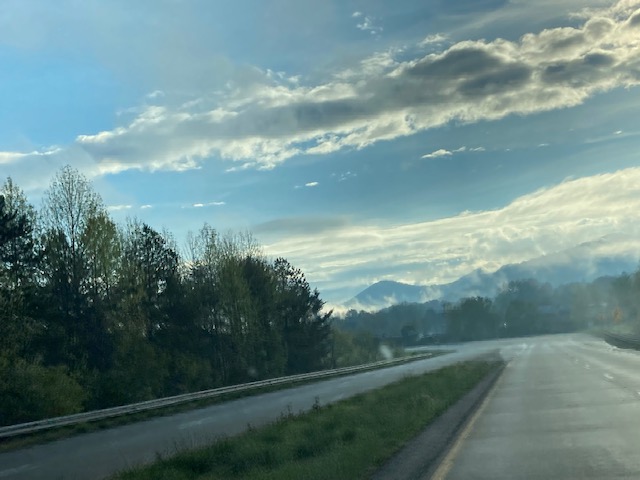
As the elevation climbed, the azaleas and dogwoods, planted by landscapers, gave way to the natural beauty of bluets, mountain laurel, and yellow poplars. The season had passed for blossoms of the bright-yellow tulip-like flowers for which the towering trees were also named. But they joined the dense thickets of Catawba rhododendrons to give the hillsides a lush, green blanket. Frequently, rock formations protruded along the roadside, sustaining a resolute form of plant life jutting from sheer stone, adding to the rugged splendor. The determination of those plants to survive among the boulders mirrored the persistence of the mountain folk there.
Despite the natural loveliness of the region, my apprehension regarding the future returned as I passed through or near small towns with familiar names, but whose appearances were now foreign to me. I couldn’t get daddy off my mind. For everything else that lay in the past, he was my only living blood relative from my early life, too. Seeing him would be difficult, but somehow losing him would to be far more heartbreaking. I was unsure what I might say to him or how to put it. How do you fill the void and distance created by years of silence and separation? Now was not the time for shouts of retribution or recrimination, at least not from me. I just prayed I wouldn’t be too late.
As I entered the town where I’d grown up, little of it seemed familiar. Where land once held woods and cow pastures, a large shopping complex had sprung up. It included a sizable discount department store and a major home improvement warehouse, separated by a cluster of smaller retail shops. Nearby, a line of ubiquitous fast-food restaurants stood sentry next to the four-lane artery. A small hotel had been built on an adjacent hilltop, no doubt to house the multitude of leaf peepers and apple festival attendees who flocked to these once-bucolic hills every fall. Apple orchards were still in abundance. I noticed that they’d even expanded the chicken processing plant significantly since my departure.
I stopped for gas and a bottle of water at a station that doubled as a convenience store. After paying for my purchases, I asked the clerk, who appeared, as they say in these parts, “not from around here,” for directions to the nursing home where my daddy now lived. He was “bery unable” to help me. It occurred to me the problem was his difficulty with the language or the fact that he, as so much else I’d seen, was new to the area.
Outside, I saw an older man in bib overalls and short sleeves, chaw-in-cheek, fueling his truck. I sought his help in finding my way. After squinting at me briefly with a glint of recognition, he gave me the information I needed. Frankly, he looked vaguely familiar to me, too, but I said nothing. I drove away with the fellow watching me, still seeking that morsel of identification buried somewhere in his memory.
As I followed the directions I’d been given, I came to the roundabout in the center of town. A flood of warm memories washed over me like so many ocean waves I’d bounced in at Maryland’s Eastern Shore. Recollections of Fourth of July parades and Christmas pageants I’d watched from the sidewalks floated through my mind. Also, there’d been Memorial Day services for which I’d gathered with the other schoolchildren at the veterans monument in the middle of the traffic circle. Those and many other reminiscences brought tears to my eyes even after all these years.
The buildings on the roundabout, which once held a family-owned hardware store, a barber shop, a mom-and-pop diner, and various other sundry stores, had all changed. Now they housed real-estate offices and antique shops to cater to the horde of tourists and newcomers to the region. On a road running out the other side of town, I located a low, sprawling, white building with a sign by the road identifying it as the Belvedere Assisted Living Home I sought. It appeared to be of much more recent vintage than the nearby structures. Somehow that was a comfort.
On entering, I approached the front desk. A short, matronly woman with a florid complexion and wearing a colorful, flowery smock asked if she could help me. The brightness of her attire failed to bring me the cheerfulness it was no doubt intended to convey.
I swallowed hard, fearful of arriving too late. “Is… is Mr. Howard Gilbert still here? I want to see him if he is. Can you tell me what room he’s in?”
“Are you a friend or a member of the family?”
The tone of her question gave me a measure of relief: daddy was yet alive. “I’m his daughter.”
“Oh, I didn’t know. I’m sorry. He’s been visited by several people, but they’ve been old friends.” Looking at a list, she continued, “I wasn’t certain he had any living relatives.”
Feeling an inexplicable need to explain, I said, “I moved away a long time ago. I haven’t seen daddy for a number of years. The owner of this home, whose family apparently has known him for some while, tracked me down and called to say I needed to come there immediately. How is he?” I realized how odd the word “home,” used regarding this town, sounded coming from me after this length of time.
“Oh, I see. Well, he was doing well for a man his age, but recently, he’s steadily declined. He’s not doing very well,” she said, looking suitably sympathetic. After a momentary pause, she realized my anxiety and went on, “I am sorry. He’s in room 151. He should have had his lunch by now. I’ll take you to him.”
As we walked along the corridor, the various nursing home smells and the click-beep-click of electronic monitors coming from everywhere only added to the gloom I was experiencing. My guide continued to chatter. “I reckoned you to be from around here somewhere. Only a southern girl calls her father ‘Daddy’ no matter how old she gets to be,” she smiled, proud of her observation. “There’s been such a migration to this area over the last ten years. It’s hard to find a native nowadays.” She stopped, turning to me with an open-palm gesture extended toward a door, and said, “This is his room.”
I hesitated and saw the room number and daddy’s name handwritten on a card on the doorjamb. As I braced myself, I smiled and thanked her for her kindness. She just remained there in the hallway, facing me for a moment. I gently assured her I needed no more help. This was not a scene to which I wanted any outsider as a witness, regardless of the emotions to be spent. She grinned awkwardly, nodded, and left me. I pushed the partly opened door and eased in. The bed closest to the entrance was unoccupied. Daddy’s bed sat next to the window.
The initial shock of what I saw made me cry aloud: his severely emaciated frame lay in a pair of pajamas, an oxygen tube running to his nostrils; his hair was light and thinning, with alleys of liverish skin showing through; he received a fluid intravenously; a monitor of some sort clicked nearby observing something, maybe his heartbeat; his breathing was shallow and labored.
My father had always been a proud, tall, powerfully built, robust, God-fearing man, made hard and strong by the rough mountain life he’d lived. Not now. The loose pajamas he wore clung to his body as if struggling to keep from falling to the floor. To say that the person before me amounted to a mere shell of the man I’d known was an understatement of enormous proportion. I could not stop my weeping. At that moment, he became aware he wasn’t alone. He slowly opened his eyes at my sobbing.
“Who’s there?” he whispered, as he tried to focus.
I fought desperately to hide any emotion except joy as I quickly wiped away my tears. “It’s me, daddy.”
“Kitty?” he asked, as his voice gathered renewed strength, yet was very raspy. “Oh, Kitty.”
I laughed and cried at the same time. “Yes, daddy, I’m here.” My given name is Katherine. Only my daddy ever called me Kitty. I’d not heard the name in years.
I stepped to the bedside and tenderly grasped his hand as he made a feeble effort to reach out to me. Leaning over, I kissed his forehead and lingered there with sadness and happiness tearing at my heart. I moved a tray of untouched food, pulled a chair to the bed, and sat. He weakly turned his head so that our eyes met for the first time in decades. The love in his eyes filled the void I’d been so concerned about earlier. Tears trickled down the sides of his face. “Baby, I’m so sorry.”
“Me, too,” I cried, as I squeezed his hand slightly. “But it’s all right now. I’m here. We’re together again. It’s okay.” Trying to regain some semblance of composure, I continued, “So, how are you feeling? Is there anything I can get you?”
He tried to look around at the medical apparatus that surrounded him, but closed his eyes in apparent pain. When he spoke at last, his words came slowly and with difficulty, “They got me hangin’ on waitin’ an’ hopin’ for you. As far as what you can git me, I’d love some of that down-home cookin’ you used to fix for me. Ever’thin’ here tastes like cardboard. I think the cook is a Yankee. I ain’t had a decent meal since you left.” He looked into my eyes and smiled feebly. “You’re still the spittin’ image of your momma.”
I started to cry again, resigning myself to the fact that there was just no way I might hide my emotions from him. Through the tears, I teased him. “You get up out of that bed, and I’ll take you home and fix you whatever you want.”
His body shuddered as he began crying. “I got no home no more, Kitty. This is it.” This once-proud man looked away pathetically, as if in shame. Before I said anything, he turned back to me and spoke, “Baby, that’s partly why I wanted to see you before I die. The old house an’ land is gone. They had to sell ‘em so’s to git the money for me to stay here.”
“Well, daddy–”
“No, Kitty, I ain’t askin’ to be taken in by you an’ your family. That ain’t what I’m sayin’.” He paused for a long moment, and then said, “You got to tell me about your family. Please tell me about ‘em an’ what you’ve been doin’ all these years.”
We talked through a lengthy reintroduction, talking of my life since leaving, and a brief biography of my family, including the obligatory photographs of David, our children, and grandchildren. Daddy acted genuinely pleased with the way things turned out for me. As he gazed at my family’s pictures he held in his frail, trembling hands, my heart ached, wishing he could meet them just once before he died. When the conversation waned, he became silent and still. I thought he was tiring, that perhaps I should leave and come back when he’d had time to rest. But he slowly turned and gave me a hard expression. In a solemn voice, he said, “Before I die, an’ I mean to pass right here in my county, my home state, I need to tell you somethin’ I done years ago before you was born.”
The gravity in his voice took me aback me. He was obviously desperate to relate something to me. I didn’t know what to say, so I nodded and listened as he composed himself and continued with the story.
“Several years before your birth, before your momma an’ me got married, I was best friends with a boy named Silas Harper. We went ever’where an’ did ever’thin’ together. Some folks, who didn’t know no better, thought we was brothers, ‘stead of friends. There’d been three of us that was best buddies back then, but then there happened a real bad fallin’ out between Harper an’ the third boy, named Artis Knight. It was on account of a girl. ’Cause Silas an’ me was closer an’ for a longer time, when the two parted ways, I just naturally stepped away from the Knight boy, too. Then, out of cussedness, Artis started doin’ stuff to raise Harper’s dander up. Well, he raised mine up at the same time.”
Here, daddy paused, trying to catch his breath to continue. I smiled at him, but the gesture went unanswered. He seemed troubled about his feelings and uncertain in the way to tell me the story. After he collected his thoughts, he continued, “Anyways, ever’one hereabouts knowed of the bad blood between Harper an’ Knight. Well, one night, there was a fight an’ Silas got stabbed an’ killed up on Rabbit Hill. A bunch of folks had gone up there after a dance at the grange hall, ‘cause a moonshiner named Buck Scruggs kept a still up there an’ put out a pretty fair product.” A hint of a smile crossed daddy’s gaunt lips as if a distant, pleasant memory had returned momentarily.
He gathered his strength and went on. “That scuffle…. Though the fight was off in the distance a ways, several people seen it in the moonlight. All of ‘em swore they seen Artis beat an’ stab Silas. When the High Sheriff investigated the killin’, he set the time at around 2:00 a.m. Problem was no one knowed the time for sure. Nary a soul around here ever owned a watch in those days. You could always tell a railroad worker or a lawyer or a doctor, ‘cause they’d have a pocket watch. They’s the only ones could afford such then or even really needed ‘em. Anyways, the sheriff arrested Artis for the murder of Silas Harper.”
Again, daddy paused and rested for a minute. I gave him a drink of water. But he didn’t wait long before he continued. As he spoke, he had a faraway look, as if reliving the entire experience.
“‘Course Knight swore he knowed nothin’ about it an’ was somewheres else when it happened. Trouble with that was he couldn’t prove it. Nobody saw him. He said he’d gotten one of Scruggs’ jugs—that’s what we called Scruggs’ Mason jars of shine—an’ wandered off to drink hisself into a fog. Be that as it was, the witnesses held firm in their testimony. Some argued that Artis had raised the ire of more than one person in the county.
“They put him on trial in short order, an’ it finished one day at the end of the workday. The judge told the jury to come back the next mornin’ to start their deliberations. Practically the whole county’d been attendin’ the trial, and nobody doubted what the outcome would be. A few was aggravated that the judge just didn’t let the jury go ahead an’ take the ten minutes they needed to convict him right then an’ there. Artis was gonna be hanged, sure.” Once more, a tear rolled down daddy’s cheek. His eyes moved to mine with a mournful look on them.
“Daddy,” I interrupted, “you should rest for a while. You can finish the story later. I’m not going anywhere.”
“No, please, Kitty,” he protested as strongly as his condition might allow. “I have to tell you this before it’s too late.” He swallowed hard. “I don’t know how much time I got.”
I couldn’t ignore his strong desire to continue, and simply nodded. He seemed relieved at my acquiescence.
“The night before the jury started deliberatin’, Artis escaped from the county jail an’ disappeared. Some figured he skedaddled off an’ got killed later in the war. Others claimed he just run like the coward he was and started fresh somewheres far off from here. Well… Kitty… I need to tell you somethin’ I done. I busted Artis out of that hoosegow. Never admitted that to no one, ‘cept here, and now, to you.” As he stopped talking and looked away, I tried to read his face. After years of separation, I couldn’t tell if I saw shame or uncertainty in his expression.
I was still trying to sort it out when he turned his head back to me and elaborated, “Only one deputy would be guardin’ Artis the night he escaped, an’ I knowed it. Heck, the whole town knowed it. They was all convinced of Silas’ guilt in the murder. Nobody worried that he might git let off after his trial. Ever’one knowed he was goin’ to be convicted an’ hanged. An’, like I said, Artis had done aggravated most ever’body in the county with his wild an’ crazy ways. So not a lot of concern was paid to anythin’ such as extra guards or security. Besides, no one’d ever busted out of that lockup. You probably don’t recall, but back then, the jail wasn’t much compared to nowadays. It was a small building with two cells abuttin’ the old courthouse just off the square.”
As I smiled, recalling that everyone referred to the downtown roundabout as “the square,” despite the obvious difference in shape, daddy continued. “The jail had what they called a front door that led into the courthouse proper an’ a back door that opened to the alley where they parked both the sheriff’s office cars when they wasn’t out on business. The sheriff always drove his car home, an’, thankfully, he’d left before I got there that night. I doused the outside door’s light an’ banged on the door. When the deputy opened it, I popped him good with my fist an’ he dropped like an old oak. He never knowed what or who hit him.
“I went inside to Artis’ cell. He thought I was there to kill him ‘cause of him murderin’ Silas. He was a mule-headed son of a buck. It took ever’thin’ I could do to convince him I come to get him out an’ away safe. Finally, we made our way right quick to my wagon, tied nearby, an’ got out of town as fast as possible. I broke Artis out of that cell. I just couldn’t let ‘em hang him.” With this, daddy appeared to sink further into his bed and relax. An idea occurred to me, but I said nothing.
Daddy’s voice had grown steadily weaker as the telling of this narrative took its toll. He’d been struggling to keep his eyes open. Thankfully, as he imparted his last piece of the story, he drifted off to sleep. His confession shocked me! But what was I supposed to do with the information? He obviously needed to get this off his chest before he met his Maker. As I sat there pondering what he’d told me, I had a question I wanted desperately to ask him, but it would wait until he’d rested. I glanced at my watch and was stunned to see the lateness of the hour. Afternoon visiting hours surely had to be over by now. I left the room. Making my way to the front desk, I found Gertie sitting there. She looked up and smiled.
“Well, did you have a pleasant visit?”
“Yes, thank you. Daddy drifted off to sleep. He seems exhausted, so I’m going to leave and return in the morning. What time are your visiting hours?”
The woman became serious as she stood and leaned closer to me. “Don’t you worry about the hours, Honey,” she whispered. “You come on back when you can. I’ll be here. See me, okay?”
I nodded gratefully.
“Did you just get into town? Do you have a place to stay?”
“Well, yes, and no. I guess I’ll go to that hotel out on the highway.”
Before I uttered another word, she threw her hands up and proposed, “Look, Honey, I don’t know what your purse allows, but there’s a bed-and-breakfast between here and town that’s really nice. And spotless. It’s a little more expensive than that hotel, but it feels like home. A friend of mine owns it. Just tell her Gertie sent you and I said to give you the ‘hometown’ rate. She’s got a big porch looking out over the woods toward Walnut Mountain. Get a cup of tea and go out on the porch. You’ll love it! And if you need a place for supper, try the Taylor House Restaurant right off the square on Main Street.”
It sounded great to me! I was drained and ready for a homelike setting versus an over sanitized, at least theoretically clean, hotel room. Gertie assured me she was going down to daddy to see that he had his medications and was set for the night. After thanking the woman for her kindness, I made my way to the car and started toward town. I found and checked in to the recommended bed-and-breakfast. The owner turned out to be a charming lady who made me feel as if a special guest. It was a comfort after an extended, arduous trip. The room was very comfortable. And dinner at the Taylor House was equally nice. I thought the name sounded familiar when Gertie mentioned it. It had been a family-owned restaurant when I called the area home. The same people still operated it.
After a pleasant meal, I walked around “the square.” Most of the real-estate offices posted listings in their front windows. Looking at some offerings made me gasp. The enormous sums being asked for and, in fact, received for land and homes in the area astonished me! I only shook my head in amazement.
Later, I stepped out into the bronze late-afternoon light and sat on the porch of the bed-and-breakfast with a glass of wine. The setting was as glorious as Gertie promised. As I listened to the chorus of cicadas fill the evening air, I considered the things daddy shared with me earlier. What was I to do with his confession? I didn’t condone what he had done, but, whatever his actions back then, they seemed to me to have lost their significance over the intervening decades.
I gathered that his previous friendship with one man simply overcame his grief at the loss of another. He probably thought that, since hanging Artis wouldn’t bring Silas back, he shouldn’t let it happen. Rather than lose two friends, he took matters into his own hands. Seemingly, this Artis Knight had either been killed in the war, as some speculated, or had gone on in life “to sin no more.” Regardless, no one heard of him again. No, I certainly wasn’t going to the authorities with what daddy had told me. His shame at telling me the story was clear enough without making the situation worse by exposing it to the public. Besides, what might be gained by it at this late date?
But another thing now weighed on my mind: the question I’d wanted to ask earlier. When I was growing up, I remembered an “uncle” named Arthur who came to our house for brief visits, but he never brought any suitcase or bag with him. He was friendly enough, but always acted restrained. We never went anywhere while he visited, and daddy never invited anyone else over during the man’s presence.
I recalled that he often told me in very strong terms that I was never to mention Arthur or his presence to anyone, because he was a sort of hermit and a little “pixilated,” as he had put it. Ever the obedient daughter, I never mentioned Arthur. Because I left home as soon as possible after high school, I never heard what’d become of him. Now it seemed likely to me that “Uncle Arthur” was actually Artis Knight. And I believed Artis had lived somewhere up in the thick forest and undergrowth of our mountain.
Artis’ presence up on the ridge might also explain another thing about which daddy periodically cautioned me. More than once, he warned me not to go up the mountain. He told me that a family of black bears lived there, and the mamma bear was one nasty critter, very protective of her cubs. His warnings more than chilled any desire I had in my younger tomboy days to sneak a peek at the cubs or to explore our land. Later, as I grew older, I was less concerned about bears or wandering the property than getting through school and leaving. Consequently, roaming the mountaintop never entered my mind. This evening, the questions and possibilities kept spinning around in my head. So I called it a night, telephoned David and the girls, and climbed into bed. Sleep was elusive and fitful.
The next morning, after a wonderful breakfast, I returned to the nursing home. As promised, Gertie sat at the front desk. Before I spoke, she made her report.
“Honey, your daddy’s had a rough time of it, but he’s okay now. Apparently, he woke up late last night expecting to find you there. When you weren’t, he became very upset, and the nurses could barely get him calmed down. They sedated him. He’s still asleep and probably won’t come out of it for another hour or so.” Gertie’s voice reflected genuine sympathy and concern.
Trying to hide my distress at the situation, I simply said, “Maybe you should have called me.”
“The problem is, honey, in his weakened condition, he needed rest. The staff was afraid he wouldn’t sleep if you were here. They determined a sedative was the best thing for him. Anyway, do you want to go do something, look around the town and see the changes for the next hour? By that time, he should be awake and ready for a friendly visit.”
With time to kill and resting on Gertie’s assurances that daddy was stable, I decided to take a ride. “Yes, perhaps I will. But I won’t be far away if you need to reach me.” Taking a piece of paper from the counter, I wrote my phone number down, as I continued, “Here’s my cell number. I used it last night so I know I get excellent service here. Please call me if anything happens. I’ll be here in a matter of minutes. I should have given it to you yesterday, but I walked out of here in a slight state of shock.”
“Yes, seeing them this way can be very disturbing,” she agreed.
I smiled politely. Gertie was only partly right about the reason for my distress, but I let her think what she wanted. As I started to leave, I called back to her, “Oh, by the way, thanks for the bed-and-breakfast recommendation! It was wonderful!” She grinned and waved me a “you’re welcome” as I departed.
I wanted to see if I might find the old homestead. Uncertain whether I could locate it or even get to it, what with the changes around here, I had to at least try. When I was young, we’d been what folks called “the landed poor.” We’d owned a sizeable parcel of land, extending to the top of one of the local mountains. However, before the area had been discovered by the Floridians escaping the unbearable heat of their summers and Atlantans running from whatever they felt the need to leave, acreage permeated with rock and not much else wasn’t worth a great deal.
Unlike today, when people will pay a million dollars for a mountaintop tract of land on which to put a two-million-dollar home, back then, if it couldn’t be farmed, wouldn’t sustain cows, or didn’t have old-growth timber for harvesting, it didn’t bring much of a price. Owning it meant very little. That was why the prices I’d seen in the real estate office windows shocked me so.
Collecting my memories of the best way to proceed, I drove north out of town. After a time of traveling the winding, two-lane roads, I reached what had been the dirt track that led to our small house. I almost didn’t recognize it. A chain between two posts blocked the way. Nearby was a sign announcing the future site of “Black Bear Estates: Homesites from the low $300,000s, Homes from the low $800,000s.”
I sat there in the car in stunned silence as the immensity of life’s changes swept over me. Although this land was my special world as I grew up, I never imagined the value it now held. Returning to reality, I saw I could go no farther in trying to reach what might be left of the old homestead, so I headed back to town. As I traveled, I recalled daddy saying that the place had been sold to pay for his nursing care. A developer must have jumped on the opportunity to grab the beautiful mountaintop parcel we’d had. Also, he probably paid next to nothing compared to what he was going to make on it.
At the nursing home, daddy was awake and eager to talk more, though still very weak. He had himself propped up as much as he could be, so we might visit better.
“Kitty, I’m sorry ‘bout yesterday. I didn’t mean to drift off that a way. I don’t have the strength I used to. If you have time, there’s somethin’ more I need to tell you.”
“We have plenty of time. I’m just so glad to see you.” When I attempted to steer the conversation to other things, daddy appeared more concerned to take up where he’d left off the day before. I assured him he didn’t have to explain anything to me. I told him I loved him and understood why his friendship with Artis led him to do what he’d done. He tried valiantly to shake his head emphatically at my comments.
“You don’t understand, Kitty. There’s more to the story than I told you yesterday. Lots more.”
Concerned over him getting upset, I reassured him that my guess was that “Uncle Arthur” might well have been Artis Knight. He seemed relieved that I’d correctly guessed that much of his tale. Daddy confirmed that, yes, Arthur was Artis. He also told me they’d agreed to use the name “Arthur” in case I, as a child, slipped up and mentioned him elsewhere. But daddy was determined to return to the story where he’d left it.
“Let me start back,” he began weakly, “to after I broke Artis out of jail. I tried my best to git Artis to leave town. I even offered him what few dollars I scraped together to start him out. But, like I said, he was the most cantankerous, stubbornest man I ever knowed. Artis just flat refused to go. He told me that this place was his home, an’ he intended to die here.” Daddy hesitated and swallowed hard, a tear sliding down his cheek in his understanding of what his friend had felt. “I put Artis up in that old logger’s shack at the top of our property. He come from dirt-poor stock, even poorer than my people, so that shack weren’t a big change for him.
“Nobody ever went up there anyways, so’s he was out of sight. I’d take him food now an’ then. And Artis grew a few vegetables. Not much, though. He’d trap for a little meat, too, up on the mountain. He become pretty good at it. Plenty of squirrels, wild turkey, an’ such for him to catch. He even snagged a deer a time or two. So he made out. He just didn’t see the wisdom of movin’ on. My biggest fear was that the revenuers might come snoopin’ around an’ find him, but it never happened. An’, of course, on a signal from me when it was clear, he’d come down to our place ever’ so often, playin’ your Uncle Arthur. Nary a soul ever knew. Couldn’t do it today, what with the developers an’ surveyors roamin’ the county.”
Daddy stopped his story and asked for a drink of water. I began to be anxious about the exertion of his talking. He seemed so frail, but insisted on continuing. As I helped him with the glass, I told him that Artis was not the only mule-headed person in the county. He showed me another faint smile.
“Artis lived up on that mountain that whole time, an’ nary a soul knew. Several years ago, I hiked up one night to take him some food an’ check on him. He’d been feelin’ poorly of late, an’ I was worried sick ‘bout him. I found Artis dead in the shack. He’d finally give out. I buried him that night near the shack he called home all that time. Over the years, we’d become fast friends again. He sorta took the place of Silas an’ really became my best friend, Kitty.”
Daddy clasped my hand as tightly as his weakened condition allowed. He sobbed softly for a minute, and then said, “Kitty, I’m afraid that they’ll find his remains now that they’re gonna develop the land. They’ll be diggin’ ever’where. When they do, I know they’ll git the sheriff, who’ll call somebody, who’ll use their fancy science to figure out who he was. Ever’body’ll know I busted Artis out an’ hid him.” Daddy paused again. “When God took your momma from me, He was punishin’ me for what I done.”
“After all this time, I don’t think anyone will care. You helped a friend. And God didn’t take momma to punish you for helping Artis.”
He closed his eyes, shook his head, and whispered, “But it don’t stop there, Kitty. You don’t understand yet. There’s more I got to say. When the sheriff figured the hour Silas got killed, I was helpin’ my pa calf a cow. We knowed the time ‘cause ol’ Doctor Johnson passed our way comin’ back from deliverin’ a breech baby at the Murray place. Doc stopped an’ visited with Paw a spell, seein’ if we needed any help with the calf. Like I said, Doc owned a pocket watch an’ mentioned the lateness of the hour. An’ Artis couldn’t prove where his whereabouts when Silas was murdered.”
“I don’t understand. What does–”
He raised his hand slightly to stop me. Choking back tears, he whispered, “It was such a mess, Kitty. You see, Silas, same as Artis, got drunk the night he got killed. In his drunkenness, he run into my girl, my intended, your momma, goin’ home from the dance, an’ he messed with her. When I found her a little later, she was hysterical. I made her tell me what happened. She was the most precious thin’ I ever knowed up ‘til then.” With this, he squeezed my hand gently and tried to grin, but the painful memories he relived kept the promise of a smile from being fulfilled. He cried. I cried. I didn’t know what to say.
Sobbing, daddy continued, “I went crazy. I tracked Silas up to Rabbit Hill an’ found him a short distance from the gatherin’ of folks there at the Scruggs’ place. He was drunk as a skunk. When I confronted him with the god-awful truth of what he’d done with your momma, he pulled a knife on me. He was my best friend…. I always knowed that, when Silas’d drink, he’d git tetchy. The liquor must have made him loco or he wouldn’t have done her wrong like that, an’ he wouldn’t come at me with his knife.
“Some time later, I figured that, in his drunkenness, maybe his mind confused me an’ Artis, since we was both ‘bout the same size an’ colorin’, it bein’ dark an’ all. I reckon that the other fellars at Scruggs’ that night reckoned I was Artis, too, in the moonlight in the distance, what with Silas bein’ murdered an’ there bein’ bad blood between the two of them. Anyway, we fought over the knife an’ I stabbed him with it. I killed him. I murdered my best friend, Kitty….”
Daddy wept quietly before continuing, “When it was over, I ran home. You see, baby, the sheriff didn’t reckon the time of the killin’ right. It was me, not Artis. I murdered Harper. That’s what they’ll learn when they dig our land. When I heard some developer bought our place, I had to tell you before they learned it. I needed to let you know, darlin’, that, durin’ those years, I wasn’t angry at you ‘cause your momma died givin’ birth. You thought I blamed you, an’ I knowed it, but I didn’t know how to tell you otherwise without tellin’ you the whole truth.
“I was mad at myself ‘cause of what I saw as God’s punishment of me bein’ took out on her. I was so ashamed an’ so scared. I’ve always loved you with all my heart. Always. I was just so afraid God might take you, too. An’ when you left like that, I reckoned it to be God’s way. I was so grateful He spared you. I love you, Kitty. Always have.”
I cried with him. I held him as we cried. So many years wasted, so much misunderstood. I stood and walked to the room’s tiny bathroom to rinse my face and get a damp washcloth for him. When I returned to his bedside, daddy was gone forever. I held him close as I cried again, longer, deeper than before. My guess was that daddy decided he’d lived long enough to set the record straight. More important, we’d renewed the love between us that had always really been there, buried beneath a mountain of regret. I will forever love my daddy and the mountains in which he lived and died. ©